

THE DETERMINANTS OF E-COMMERCE IN TURKEY AND EUROPEAN COUNTRIES: A PANEL DATA ANALYSIS
Doç.Dr.Emre Kadir Özekenci tarafındanABSTRACT
In recent years, electronic commerce has become an important topic in the business environment due to rapid development in science and technology. One of the major developments of the past two decades has been the growth of the internet for business transactions among firms. Thus, e-commerce has started to effect businesses and individuals immensely. The main purpose of this study investigates the determinants of e-commerce in Turkey and European countries. Panel data has been used in terms of analyzing factors affecting e-commerce by using macro variables, for the period of 2004 and 2015. Empirical results indicated that internet users, GDP per capita, inflation, and employment rate by educational level have positive effect on ecommerce.
1 | INTRODUCTION
Individuals and firms have made commercial activity since the beginning of human civilization. However, commercial activity has transformed in each period, and today it has become more complicated compare to previous periods. One of the major developments of the past two decades has been the growth of the internet usage for business transactions among firms. The total number of internet user was 1 billion in 2005 and it has increased to 3.5 billion within 12 years in the world (Statista, 2017). In addition to that, almost half of the world population has an internet connection today, it was less than 1% in 1995 (Internetlivestats, 2017). Therefore, the internet is dramatically expanding opportunities for ecommerce transactions across borders (Terzi, 2011). Up until 15-20 years ago, businesses focused mostly on their home markets due to several factors; technology not being sufficiently developed to allow firms and individuals to access the wider market place, and firms not being aware of the extent and potential of other markets and consumers.
Towards the end of the nineteenth century, the world saw the emergence of the “new economy” (information economy) which rapidly spread due to significant changes in social and economic structures. The new information economy, based on technology and driven by computers and the internet, has created significant changes globally. One of the fastest growth channels created by the new economy is e-commerce; the buying and selling of goods and services, or the transmitting of funds or data over electronic networks, primarily the internet (Dixit and Sinha, 2016). As a result of e-commerce, the volume of services and the quality of goods offered on the internet have increased significantly. This advancement in information technology, permits many businesses to implement e-commerce models in their transactions to enable them to compete more effectively, and gain competitive advantage over their competitors. Thus, development of e-commerce has created significant challenges for firms in the business environment.
The main purpose of this study is to investigate the main determinants of ecommerce in Turkey and European countries. Existing studies on e-commerce are scarce due to the availability of data and time periods covered. Baydar (2010) investigated the main factors affecting e-commerce for the period 2003 to 2008, Türen et al (2011) examined factors affecting e-commerce volume in Turkey for the period 2004-2010, Peker (2015) analyzed factors affecting e-commerce development in Turkey for the period 2010 and 2014. In this study, we controlled ecommerce on internet users, GDP per capita, inflation rate, employment rate in total and employment rate based on education level. All these variables were used to explain factors affecting e-commerce in previous studies. In this study, the time period to be examined is extended and added extra variables, such as employment rate by educational background. Therefore, we disaggregated total employment rate based on educational background, and panel data has been used to analyze the determinants of e-commerce in Turkey and European Countries. Consequently, this paper investigates the determinants of e-commerce in Turkey and European countries. Applying dynamic GMM for a panel of 31 countries- Austria, Belgium, Bulgaria, Croatia, Cyprus, Czech Republic, Denmark, Estonia, Finland, France, Germany, Greece, Hungary, Iceland, Ireland, Italy, Latvia, Lithuania, Luxembourg, Malta, Netherlands, Norway, Poland, Portugal, Romania, Slovakia, Slovenia, Spain, Sweden, United Kingdom and Turkey- for the years 2004 to 2015, we found internet users, GDP per capita, population to be of essential determinants of online purchasing, while inflation is found to be negative effect on e-commerce.
2 | BACKGROUND: E-COMMERCE GROWTH
In this part, we discuss the background of ecommerce respectively; cross country e-commerce research, identifying drivers that affect e-commerce and panel data research regarding e-commerce. In the next section, e-commerce is defined to specify what we study and model in this research.
2.1 | Definition of E-commerce
Most researchers, businessman and organizations define e-commerce in different ways depending on the research objectives of the researcher, or the context. There is no commonly accepted definition of e-commerce among businesses and organizations. The discussion of e-commerce definitions intends to give idea of our application and deliver new knowledge. Zwass, (2003) defines e-commerce as “the sharing of business information, maintaining business relationships, and conducting business transactions by means of telecommunications networks. According to the definition made by Fraser et al in 2000, e-commerce refers to conducting business transactions over the intranet, which includes exchange of information of value in the form of products and services as well as payment, using web-based technologies. As defined by Grandona and Pearson in 2004, e-commerce as the process of buying and selling products or services using electronic data transmission via the internet and World Wide Web. Ige (2004) stated that, e-commerce is “the sharing of business information, maintaining business relationships, and conducting business transactions by means of telecommunications networks. Chaffey in 2009 define e-commerce, “all electronically mediated information exchanges between an organization and its external stakeholders. Kauffman and Walden, (2001) state “the Internet as a medium for enabling end-to-end business transactions. We seek to identify suitable definition regarding e-commerce that emphasizes the B2C side of e-commerce due to our research and data set is focused on individuals buying goods and services on the internet. Therefore, we focus on B2C e-commerce definition with version of multiple scholars; (Treese and Stewart, 2003; Kauffman and Walden, 2001; Laudon and Traver, 2014). These three definitions of B2C e-commerce have common grounds. Most of these definitions refer ecommerce as buying or selling activities between organizations and individuals over the internet.” Their definition also indicated that internet is a way of doing transaction for businesses and consumers by sharing information, money, time and energy. Therefore, in our study we will adopt the definition of B2C ecommerce as: “an electronic commerce model that allows the businesses and individuals make commercial transaction for their own uses by the help of internet”. We believe that this definition best fits the concept of our study and fits our data set.
2.2 | Determinant of E-commerce Growth
The new information economy is shaping the world trade today and changing the rules of the game for many participating actors. According to the “Worldwide Retail and Ecommerce Sales: eMarketer's Estimates for 2016–2021” report, the ecommerce sales worldwide will continue to post solid gains in 2017, rising 23.2% to $2.290 trillion. In 2017, for the first time, ecommerce sales will account for one-tenth of total retail sales worldwide. This dramatic change also gets the attention of scholars living in different parts of the world. There have been many aggregated studies conducted regarding Global E-commerce growth. The determinants of e-commerce growth or technology adoption in different nations, has been one of the most common issues that that has been examined by scholars. Ho et al., in 2007 summarized the main drivers or determinants of e-commerce growth under six different categories. According to Ho et al., 2007 1) national wealth, 2) geographic and demographic characteristics 3) the availability of information infrastructure, 4) adequacy of economic and financial resources 5) the average level of education and the quality of human capital and 6) the level of urbanization in a certain nation are the main categories that drive the e-commerce growth in that particular nation. In our study we included five different determinants that fall under the categories listed above. Although we are not able to include all the variables that were mentioned in the earlier studies we believe that the data we gathered regarding the variables and the extent of the time period and range of countries that we included in our study will help us to understand the growth of ecommerce in a cross national level. Similar to earlier studies as an important variable that indicated the national wealth, we included GDP per capita in our study. Various studies stated that GDP is one of the driving factors for the extent of observed new product or technology development in a country (Ho et al., 2007). Therefore, GDP will help a nation to adopt a new technological improvement such as internet and e-commerce. Population is also considered as an important demographic factor that affects the nations on many levels. Thus, we included population as one of our variables in our study. The number of internet users in a nation or internet penetration rate of a nation is one of the main conditions for e-commerce to occur in the first place. So that we believe the number of internet users in a country has to be included as one of the determinants in our study. As listed above one other important determinant on ecommerce growth is economical and financial indicators, we employed inflation rate as our economic indicator. And finally, as stated by Caselli and Coleman high levels of educational attainment are proven to be critical in the extent of computer technology adoption in a country. We believe that the same principle regarding the educational attainment, would apply to new way of purchasing goods and services through internet therefore we included “Employment by educational attainment level” as our last variable.
2.3 | Methods for Cross Country E-Commerce Researches
In recent years, there has been an increasing interest in e-commerce and other technological issues. A number of researchers have examined to understand factors that affect e-commerce transactions across different countries; Caselli and Coleman, (2001); Gibbs et al., (2003); Zhu et al., (2003); Mahmood et al., (2004); Xu et al., (2004); Ho et al., (2007); Baydar (2010); Araste (2013); Peker (2015); Anvari and Norouzi, (2016); Elbeltagi et al., (2016); Coad and Duch-Brown, (2017). Although extensive research has been carried out on factors that affect ecommerce, limited study exists which investigates affecting factors of e-commerce with econometric methods. So far, this method has only been applied to limited studies; Ho et al., (2007); Türen et al., (2011); Arabacioglu, (2013); Deng and Zhang, (2014); Georgiou, (2015); Anvari and Norouzi, (2016). The methodological approach taken in e-commerce study is a mixed methodology based on questionnaire, observation, interview and focus group. However, much of the studies on the determinants of ecommerce growth have emphasized the use of econometric model; Gibbs et al., (2003); Ho et al., (2007). This view is supported by Kauffman and Walden, (2001) who state that “Econometric methods of data analysis are especially well suited for the study of electronic commerce”, In addition to Kauffman and Walden’s suggestion, econometric analysis generally gives chance to researchers to make prediction about changing environment and identify significant factors that affect e-commerce transactions by the cross-sectional analysis. Thus, it is more appropriate to make research one-commerce by the help of econometric models.
The main purpose of this study is to investigate the main determinants of e-commerce in Turkey and European countries. Existing studies on the determinants of e-commerce growth are scarce due to the availability of data and time periods covered. Baydar, (2010) investigated the main factors affecting e-commerce for the period 2003 to 2008, Türen et al., (2011) examined factors affecting ecommerce volume in Turkey for the period 2004- 2010, Peker, (2015) analyzed factors affecting ecommerce development in Turkey for the period 2010 and 2014. In this study, the time period to be examined is extended and added extra variables, such as employment rate by educational background. Therefore, we disaggregated total employment rate based on educational background, and panel data has been used to analyze the determinants of e-commerce in Turkey and European Countries. Our study cover the panel of 31 countries, the period from 2004 to 2015 with following variables; e-commerce, internet user, GDP per capita, employment rate by education level and inflation. E-commerce is dependent variable and rests of the variables are independent variable in this study. Variables are collected from various databases as; Eurostat, World Telecommunication/ICT and World Bank.
3 | DATA AND DESCRIPTIVE ANALYSIS
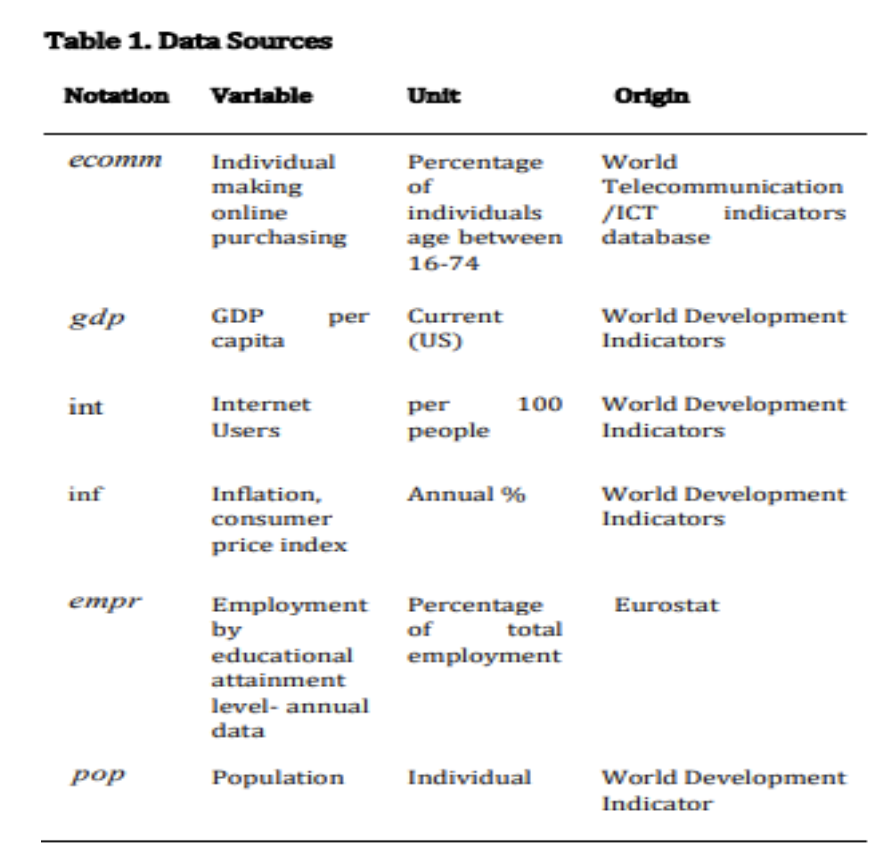
As we are to investigate the main determinants of ecommerce (i.e. online purchasing), we consider the following control variables: (1) internet user- if there is no use of internet there is no online purchasing; (2) inflation- it has an increased price effect so might have an effect on purchasing; (3) GDP per capitareflects countries well-being and the higher the better ; (4) employment rate- ability to make online purchasing; and finally (5) population, the higher the more online purchasing. Table 1 below shows the main sources where the data obtained from.
Following up the main variables to be used in our econometric model, Table 2 represents the descriptive of each variable:
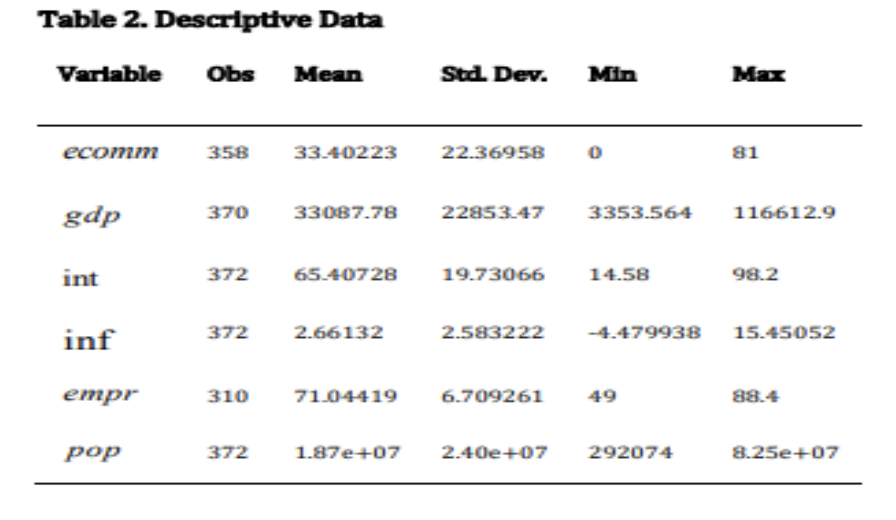
Our dependent variable - ecomm - varies from 0 to 81 per cent of individuals those who make online purchasing, with average 33 per cent. At least half of the population is employed in the countries sampled. Minimum 15 out of 100 people are using internet, which may reach up to 98 out of 100 in the countries sampled.
4 | ECONOMETRIC SPECIFICATIONS AND RESULTS
In order to investigate what factors determine the number of online purchasing; we apply the general form of the following model:

where Yi and Xi are the dependent and independent variables for each i ; α i and i ε are fixed effects and error term, respectively. Due to due the dynamic nature of internet purchasing, and to be able capture the dynamic effects, we apply the following system GMM form as follows:

Substituting dependent and all dependent variables, taking natural logarithm of variables, model (2) takes the following form:

where it lecomm is the natural logarithm form of individuals using the internet for online purchasing, it−1 lecomm is the one lagged form of it lecomm , it lg dp is the logarithm of GDP, it l int logarithm of individuals those using internet, it inf is inflation, it lempr is the logarithm of employment rate as percentage of active population, it lpop is logarithm of population, i and t are country and time subscript, respectively, and finally it ε is an error term.
Our model consists of 12 years starting from 2004 to 2015, for 31 countries. Having more N (=31) than t (=12), it is appropriate to use system GMM as it will use quite few more instruments comparing to standard GMM, and in addition to improve the precision it also reduces the finite sample bias (Blundell et al., 2001; Ahn and Schmidt, 1995). Please note that, we assume that the first-differenced instruments which are used for the variables in levels are not correlated with the unobserved country effects. Table 3 below presents the results.
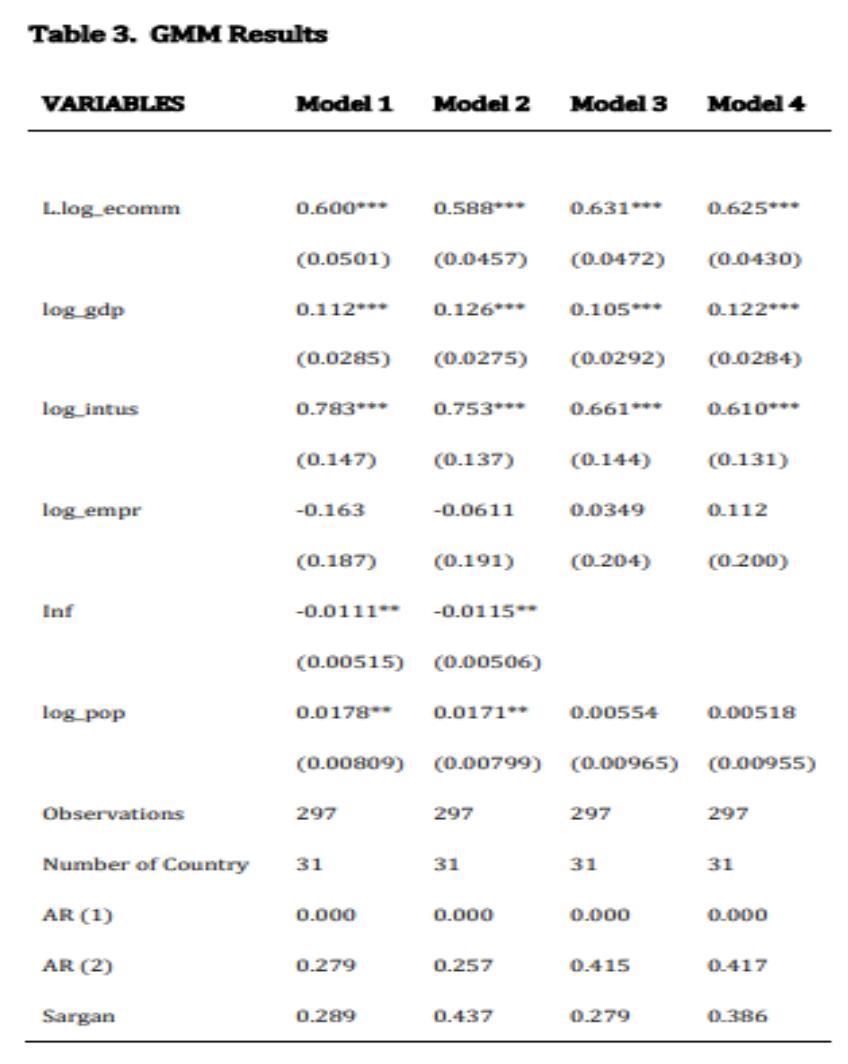
Model (1) and (3), we used to lag of dependent variable in addition to other endogeneous variables, Model (2)-(4) we use dependent variable as a source of endogeneity. Standard errors in parentheses, *** p<0.01,**p<0.05,*p<0.1
Sargan test indicates the null hypothesis of the instruments as a group is exogenous, and the high pvals indicate we cannot reject the null. The ArellanoBond test for autocorrelation has a null hypothesis of no correlation which the AR (1) usually rejects the null, yet AR (2) in first differences is more important as it will detect whether there is autocorrelation in levels. The p-valsfor AR (2) in all cases are much above the critical value of 0.05 thus we have no autocorrelation in the second order. As to the control variables, the percentages of those who do online purchasing previous year significantly accelerate the percentage of individuals online purchasing. Indeed, based on Table 3, one percent increase in the previous year’s online purchasing at t −1 will increase online purchasing by around 0.6 percent at t . GDP per capita is taken as a measure of country’s well-being (Freeman, 2008; Dieneret al., 1995; Jorgenson and Griliches, 1967), and might be of the better GDP per capita the more ability to do purchase. One per cent increase in GDP per capita increases online purchasing by 0.11 to 0.12 per cent significantly. In order for one to make online purchasing, essential element is to be able use internet. Results for the number of internet users indicate that one percent increase in the number of internet users increases online purchasing by 0.60 to 0.78 percent significantly as expected. As well known, inflation is associated with the rise in the price of the goods/ and or services. Thus, the higher the inflation grows, the less online purchasing is expected. Confirming our findings as one percent increase in inflation decreases online purchasing by 0.01 percentage points significantly. Additionally, the number of online purchasing and population may be of positively connected to one another which is approved by the significant finding suggesting that 1 percent increase in the population increase online purchasing around 0.01-0.02 per cent. One might think that online purchasing and employment rate might be positively related. Because the higher the employment rate the higher the number of people with income (i.e. ability to make purchase). However, we observe no significant link between these two. Yet, we still wonder whether disaggregating employment rate into low, medium and high skilled workers would have any impact on the online purchasing. Table 4-6 below presents the results where employment rate is disaggregated into low, medium and high skilled levels, respectively. In spite of disaggregating employment rate, we observe no significance of low educated employment rate of any kind as can be seen from Table 4. Looking at the medium educated employment rate in Table 5, we still observe no significance. Finally, in Table 6, with high educated employment rate, results remain same with no significance of employment rate of any kind.
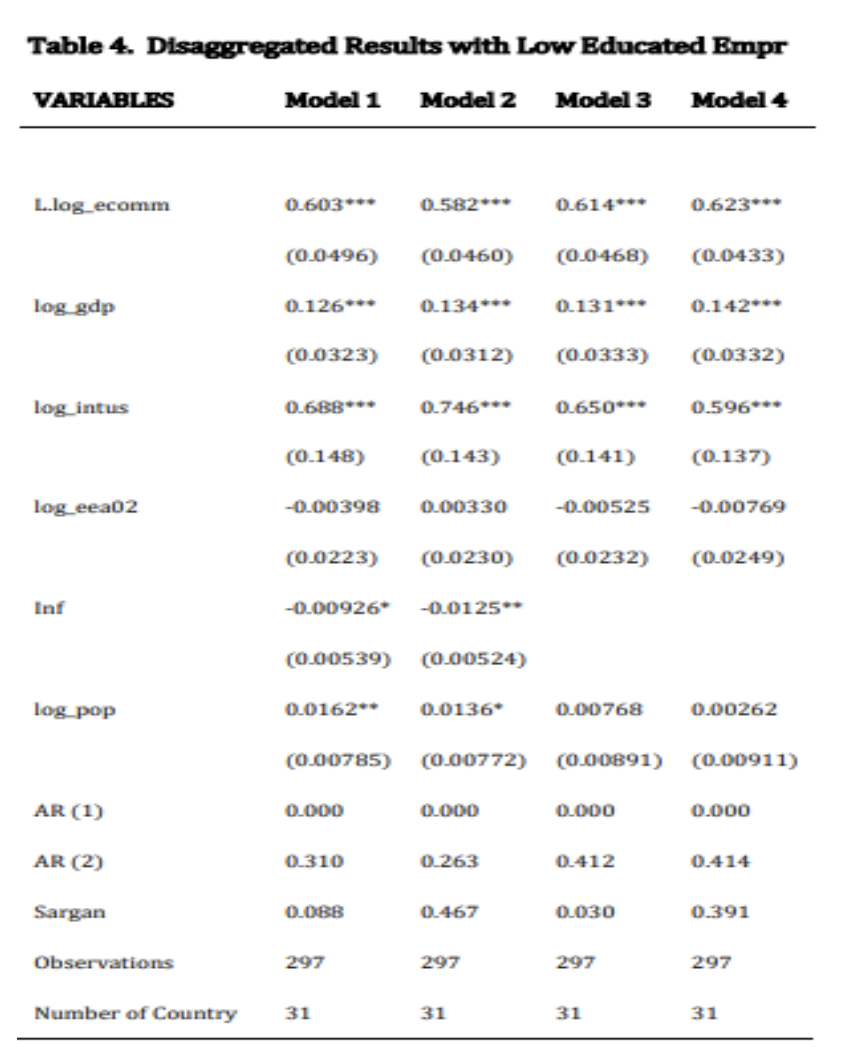
Model (1) and (3), we used lagged of dependent variable in addition to other endogenous variables, Model (2)-(4) we use dependent variable as a source of endogeneity. Standard errors in parentheses, *** p<0.01,**p<0.05,9p<0.1
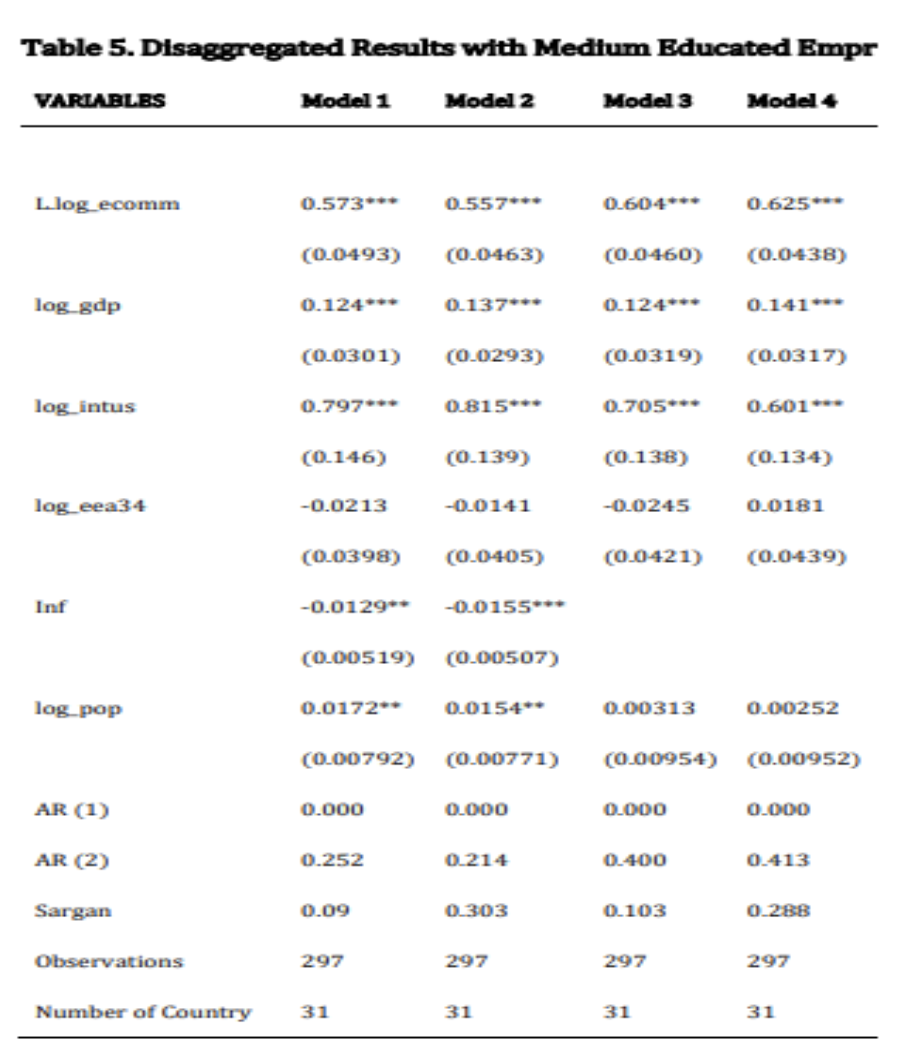
Model (1) and (3), we used lagged of dependent variable in addition to other endogenous variables, Model (2)-(4) we use dependent variable as a source of endogeneity. Standard errors in parentheses, *** p<0.01,**p<0.05,*p<0.1
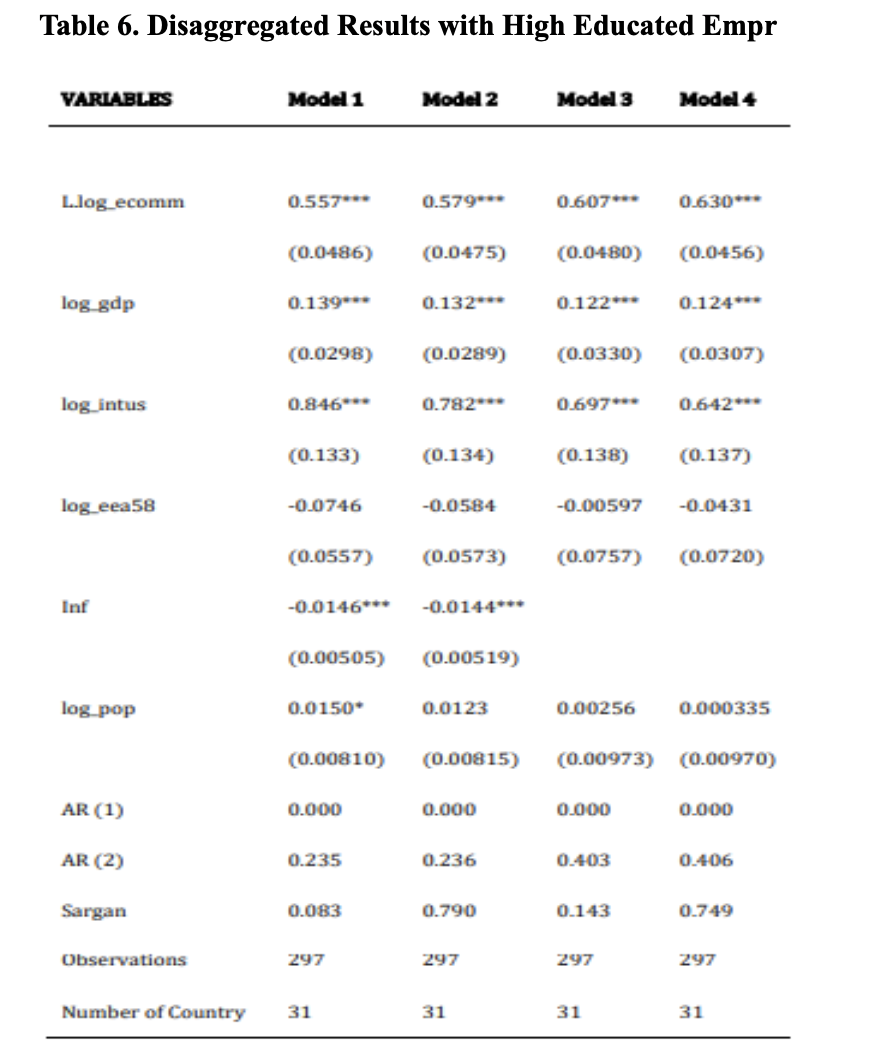
Model (1) and (3), we used lagged of dependent variable in addition to other endogenous variables, Model (2)-(4) we use dependent variable as a source of endogeneity. Standard errors in parentheses, *** p<0.01,**p<0.05,*p<0.1
Finally, remarking that employment rate of any kind has no significant impact on online purchasing, we run the regressions without employment rate to observe whether our results robust to the previous findings in Table 4-6, and presented them in Table 7 below.
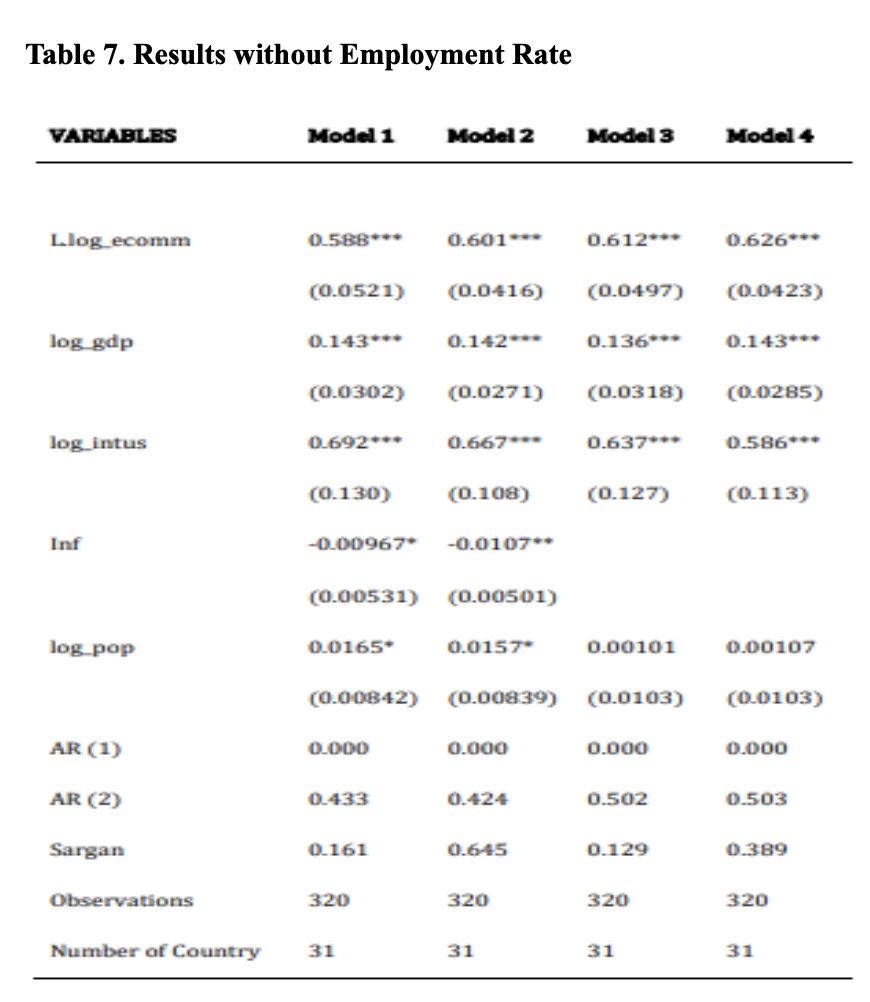
Model (1) and (3), we used lagged of dependent variable in addition to other endogenous variables, Model (2)-(4) we use dependent variable as a source of endogeneity. Standard errors in parentheses, *** p<0.01,**p<0.05,*p<0.1
As can be seen from Table 7 above, one lagged of the online purchasing variable remains quite significant in all cases. Followed by GDP per capita and internet users’ variables. Inflation and population are also stay significant. Based on the descriptive statistics of the variables in Table 2, there is quite several missing observation in the employment rate variable, and taking this variable out of the model generated more set of balanced panel with 320 observations (i.e. previously 297). Both the sign of the coefficients and the significant have remained unchanged.
5 | CONCLUSION
In this paper, we looked at the main determinants of e-commerce in 31 countries -Turkey and European countries. Applying dynamic GMM for our set of panel data for the years between 2004 and 2015, we observe a significant effect of GDP per capita, number of internet users, population, and negative yet significant inflation on online purchasing. Our empirical findings suggested a significant effect of internet user, GDP per capita, inflation and population on e-commerce. While, the effect of internet user, GDP per capita, and population on e-commerce are positive, the effect of inflation on e-commerce is negative. The significant relationship between internet user and e-commerce is expected result. The number of internet user is the most important factors affecting e-commerce. This result is quite consistent with the relationship between internet and ecommerce. In order e-commerce to be present, one needs to be internet user at first place. Therefore, internet connection is one of the major components on e-commerce. GDP per capita has positive impact on e-commerce. When the GDP per capita increases, country’s standard of living increases. However, when the GDP per capita is decrease, purchasing power of consumers declines. Therefore, there is significant relationship between e-commerce and GDP per capita. Inflation rate has negative and significant effect on e-commerce. This result is quite acceptable. An increase in the inflation rate is resulted from higher level of prices for goods and services which consequently decreases the purchasing power. Although we expected to observe a relationship between e-commerce and employment rate as such as the educational level increases in total employment, it might have positive and significant impact on ecommerce. Because, educated people may earn more money due to high status of their working environment. Also, they have limited time to visit physical store. Yet we observe no such relationship at all.
REFERENCES
Hartman, J. Sifonis, & J. Kador, Net Ready: Strategies for Success in the E-economy, McGraw-Hill, NY, 2000.
Adewale, G., Ayo-Oyebiyi, G. T., & Adebayo, S. A. (2013). An Empirical study of factors that influence the adoption of e-commerce in Nigerian business organizations. International Journal of Business and Management Invention, 2(9), 28-33.
Ahn, S. C., & Schmidt, P. (1995). Efficient estimation of models for dynamic panel data. Journal of econometrics, 68 (1), 5-27.
Anvari, R. D., & Norouzi, D. (2016). The impact of ecommerce and R&D on economic development in some selected countries. Procedia-Social and Behavioral Sciences, 229, 354-362.
Arabacioglu S., (2013) E-commerce in Emerging Economies: The cases of Poland and Turkey, Master Thesis, International Business, Warsaw.
Araste, A. R., Mansouri, A., & Jafari, M., (2013). The Factors Affecting the E-commerce Adoption in SMEs in the Industrial Towns of Zanjan-Iran: Managers' Perspectives. International Journal of Academic Research in Business and Social Sciences, 3(10), 100.
Baydar, V. (2010), E-ticaretkavramıve eticaretietkileyenfaktörlerin panel very analizi, Süleyman Demirel University, Master Thesis.
Blundell, R., Bond, S., & Windmeijer, F. (2001). Estimation in dynamic panel data models: improving on the performance of the standard GMM estimator. In Nonstationary panels, panel cointegration, and dynamic panels (pp. 53-91). Emerald Group Publishing Limited.
Caselli, F., & Coleman, W. J. (2001). Cross-country technology diffusion: The case of computers. American Economic Review, 91(2), 328-335.
Chaffey, D. (2009). E-business and E-commerce Management: Strategy, Implementation and Practice. Pearson Education.
Coad, A., & Duch-Brown, N. (2017). Barriers to European cross-border E-commerce (No. 2017-03). Joint Research Centre (Seville site).
D. Siegel, Futurize Your Enterprise: Business Strategy in the Age of the E-Customer, McGraw-Hill, New York, NY, 1999.
Deng, X., & Zhang, J. (2014). Differentiating the effects of Internet usage and wireless usage on business-to-business and business-toconsumer e-commerce. Journal of Internet Commerce, 13(2), 138-157.
Diener, E., Diener, M., & Diener, C. (1995). Factors predicting the subjective well-being of nations. Journal of Personality and Social Psychology, 69(5), 851-864.
Dixit, S. & Sinha, A.K. (2016). E-Retailing Challenges and Opportunities in the Global Marketplace Copyright© 2016.380 pages.
Doherty, N. F., & Ellis-Chadwick, F. (2010). Internet retailing: the past, the present and the future. International Journal of Retail & Distribution Management, 38(11/12), 943- 965.
Elbeltagi, I., Hamad, H., Moizer, J., & Abou-Shouk, M. A. (2016). Levels of Business to Business ECommerce Adoption and Competitive Advantage in Small and Medium-Sized Enterprises: A Comparison Study between Egypt and the United States. Journal of Global Information Technology Management, 19(1), 6-25.
Fraser, J., Fraser, N., & McDonald, F. (2000). The strategic challenge of electronic commerce. Supply Chain Management: An International Journal, 5(1), 7-14.
Freeman R. (2008), Labour Productivity Indicators, Comparison of two OECD Databases Productivity Defferintials and The BalassaSamuelson Effect, OECD
Georgiou, M. N. (2015). E-Commerce Determinant Factors: A Panel Data Analysis in EU.
Gibbs, J., Kraemer, K. L., & Dedrick, J. (2003). Environment and policy factors shaping global e-commerce diffusion: A cross-country comparison. The information society, 19(1), 5- 18.
Grandona, E.E & Person, J.M (2004), “Electronic commerce adoption: an empirical study of small and medium US businesses “, Information & Management, Vol.42 No.1, pp.197-216
Ho, S. C., Kauffman, R. J., & Liang, T. P. (2007). A growth theory perspective on B2C e-commerce growth in Europe: An exploratory study. Electronic Commerce Research and Applications, 6(3), 237-259.
Ige, O., (2004). “Electronic Shopping: Young People as Consumers“, International Journal of Consumer Studies, 28(4), 412-427
Internetlivestats, Internet user from 2000 to 2016, Retrieved Jan 7, 2017 from http://www.internetlivestats.com/internetusers/
Jorgenson D.W. & Griliches Z. (1967), the Explanation of Productivity Change, the Review of Economic Studies, 34(3); 249-283
Kalakota, R., Stallaert, J., & Whinston, A. (1996). Worldwide real‐time decision support systems for electronic commerce applications. Journal of organizational computing and electronic commerce, 6(1), 11-32.
Kauffman, R. J., & Walden, E. A. (2001). Economics and electronic commerce: Survey and directions for research. International Journal of Electronic Commerce, 5(4), 5-116.
Kenneth C.Laudon & Carol G.Traver. (2014), “ECommerce: Business, Technology, Society“, 10th edition. US: Pearson
Mahmood, M. A., Bagchi, K., & Ford, T. C. (2004). Online shopping behavior: Cross-country empirical research. International Journal of Electronic Commerce, 9(1), 9-30.
Peker, C., (2015), “Analyzing the factors affecting ecommerce in Turkey”, Fatih University, Master Thesis.
Riggins, F. J., & Rhee, H. S. S. (1998). Toward a unified view of electronic commerce. Communications of the ACM, 41(10), 88-95.
Statista, Number of internet user worldwide from 2005 to 2016, Retrieved Jan 7, 2017 from https://www.statista.com/statistics/273018/ number-of-internet-users-worldwide/
Terzi, N. (2011). The impact of e-commerce on international trade and employment.ProcediaSocial and Behavioral Sciences, 24, 745-753.
Treese, G. W., & Stewart, L. C. (2003). Designing systems for Internet commerce. AddisonWesley Professional.
Türen, U., Gökmen, Y., & Tokmak, İ. (2011). Türkiye’de E-Ticaret İşlem Hacmini Etkileyen Faktörler Üzerine Bir Araştırma: Bir Model Önerisi. Savunma Bilimleri Dergisi, 10(1), 49- 71.
UNCTAD, Information Economy Report 2015, Retrieved Dec 24, 2016 from http://unctad.org/en/PublicationsLibrary/ier 2015_en.pdf
Xu, S., Zhu, K., & Gibbs, J. (2004). Global technology, local adoption: A Cross‐Country investigation of internet adoption by companies in the United States and china. Electronic Markets, 14(1), 13-24.
Zhu, K., Kraemer, K., & Xu, S. (2003). Electronic business adoption by European firms: a crosscountry assessment of the facilitators and inhibitors. European Journal of Information Systems, 12(4), 251-268.
Zwass, V. (2003). Electronic commerce and organizational innovation: Aspects and pportunities. International Journal of Electronic Commerce, 7(3), 7-37.
Doç.Dr.Emre Kadir Özekenci

Toplam Ziyaret: 61469 Bu Sayfaya Toplam Ziyaret: 131 Bugünlük Ziyaret: 1574