

BIBLIOMETRIC ANALYSIS OF ACADEMİC PUBLICATIONS ON THE EUROPEAN GREEN DEAL WITH THE VISUAL MAPPING TECHNIQUE
Arş.Gör.Özge Çetiner tarafındanThis study was written in Turkish, and its translation was carried out by Young Diplomats. (Original study available at: https://doi.org/10.53443/anadoluibfd.1293821 )
Abstract
This research analyzes the academic publications on the European Green Deal with the bibliometric analysis method. The bibliometric data of 688 publications in the Web of Science (WoS) database on European Green Deal issue is collected. The reviewed publications were grouped on the basis of categories such as keywords, countries, authors, and thus, it has been tried to reveal the changes within the scope of various criteria. The bibliometric analysis was visualized and interpreted through the VOSviewer mapping method. In all this framework, this study aims to address the academic awareness of the European Union's (EU) initiative, the European Green Deal, which was announced in 2019 as a green transformation project by examining the publications available in the literature on this subject.
Keywords: Green Deal, Bibliometric Analysis, European Union, Mapping
JEL Codes: F50-F59
INTRODUCTION
Ensuring ecological security, environmental sustainability and protection of natural resources are gaining increasing importance on the international agenda. Behind this development is the fact that extreme weather events and environmental problems increase awareness and encourage action around the world. For example, the sky covered with smoke for five days in London, also called the Killing Fog in 1952, the emergence of fog clouds in China due to excessive coal consumption, the melting of glaciers in Antarctica and Greenland, and weather events such as hurricanes or droughts due to climate change pointed to the security risks that environmental problems may cause (Kakışm, 2022, p. 2). In addition, the determination of July 29, 2021 as Overshoot Day with the greenhouse gas emission rate reaching the highest level in 2019 and consuming the resources produced by the planet in a year within seven months in 2021 has drawn attention to the importance of environmental security again in recent years (Ecer, Güner, & Çetin, 2021, p. 126). As a matter of fact, the fact that an increase of only 1-2 C in the average global temperature can lead to the extinction of 15-40% of living species requires measures to be taken in this regard (Stern, 2007, p. 94).
With the international agenda of environmental issues, new strategies have begun to be developed for initiatives to promote a sustainable environment (Bogoslov, Lungu, Stoica, & Georgescu, 2022, p.1). At this point, the European Union (EU) has been one of the actors trying to take measures against the global crisis in cooperation. The European Commission announced the European Green Deal in 2019 in order to be successful in achieving its sustainable environment goal. This Memorandum is a new and ambitious greengrowth strategy proposed to transform the EU into an economically competitive, resource-allocating efficient and environmentally responsible society (European Commission, 2019).
This study evaluates the reflection of the initiative that started at the policy level in the academic field by making a bibliometric analysis of scientific publications on the European Green Deal. The bibliometric analysis on the European Green Deal is important in two respects. First, environmental problems and climate change are global problem areas. Global collaborations are required to solve global problems (Ziabina and Pimonenko, 2020, p. 149). Social support is also important in this cooperation. Academic studies in this field both provide community support to the initiative initiated by the EU and contribute to raising awareness on this issue by taking part in the dissemination of information. Secondly, academic studies within the scope of the Agreement can benefit the development of approaches to the solution of the problem by providing scientific support.
There are bibliometric analysis studies in the literature that examine the issue of climate change (Rana, 2020; Zyoud and Fuchs-Hanusch, 2020; Tautiva, Huaman and Oliva, 2022), the relationship between climate change and food security (Soylu and Özkaya, 2021), the human security dimension of climate change (Maretti, Tontodimamma and Biermann, 2019), the connection between climate change and health (Sweileh, 2020), sustainable waste management (Yalçıntaş, Oğuz, Yaşa-Özeltürkay and Gülmez, 2023), the concept of environmental gentrification (Aını and Görer-Tamer, 2021), the topic of the green economy (Albayrak, 2023), and the environment–energy nexus (Reyes-Belmonte, 2021). In addition, bibliometric analysis studies in the field of green consensus are also available in the literature. Ziabina and Pimonenko (2020) examined 337 publications in the fields of green deal policies, energy conservation and energy efficiency published between 1999 and 2019 and included in the Scopus database in order to reveal the links between these issues. Popescu, Dima, Radu, Dobrotă, and Dumitrache (2022) conducted a bibliometric analysis on 672 documents published in the WoS database between 2000 and 2021 on the relationship between the green deal and food policies. As a result, the study found that academic studies on this subject were mostly carried out in Italy, India and the USA. Szpilko and Ejdys (2022), on the other hand, examined 641 studies published in Scopus and WoS databases between 2010 and 2022, with EU (or Europe) and green deal in their titles, and evaluated them according to their distribution on energy, economy, industry, construction, mobility, food, biodiversity and pollution. Therefore, studies in the literature have included the expression "green new deal", which is used to express taking inclusive measures similar to the 2008 crisis, by comparing it with the New Deal, which was developed as a solution to the 1929 Great Depression.
Unlike the existing bibliometric analysis literature, this study conducts research specific to the European Green Deal announced by the EU in 2019. This purpose also reveals the limitations of the study. In order to distinguish from the studies on "green deal/deal" in the literature, studies on the expression "European Green Deal", which is the full name of the announced initiative, are examined. In addition, this study deals with all academic publications that deal with this initiative instead of titles. The study evaluates this issue within the scope of the following questions:
• What is the distribution of studies on the European Green Deal by years?
• What are the keywords frequently used in studies on the European Green Deal? In which field do the studies focus in the light of the emerging keywords?
• Which countries have the most and least work on the European Green Deal?
• Who are the authors with the highest number of publications and citations on the European Green Deal?
• In what scope or thematic context are the most highly cited studies on the European Green Deal addressing this issue?
The study in this context consists of three parts. In the first part, the European Green Deal, which is the subject analyzed, is introduced. In the second part, bibliometric analysis, which is the method of the study, is discussed. The last part includes the analysis and interpretation of the results in the light of the method used.
EUROPEAN GREEN DEAL AS A NEW TRANSFORMATION PLAN
The foundations of the emergence of the European Green Deal as a high politics area are based on two important developments that emerged in the 2000s. The first of these is the rise of green parties both in the parliaments of countries such as Germany, Belgium, Finland, Ireland, Sweden and Luxembourg and in the European Parliament. This rise paved the way for environmental issues to be handled as political issues (Kakışm, 2022, p. 7). The second is the 2008 economic crisis. The 2008 crisis started to affect the USA, England and the EU, causing economic problems such as a decrease in global trade volume and growth rates, and an increase in unemployment (Gevher and Acet, 2023, pp. 228-229). The effort to combat the 2008 crisis started the search for a new economic model in the USA. At this point, Thomas Friedman stated that a comprehensive solution should be developed that addresses environmental problems, such as the "New Deal" put forward by the then US President Franklin D. Roosevelt after the 1929 Great Depression crisis (Friedman, 2007; Bloomfield and Steward, 2020, p. 772). Therefore, he pointed out that today's problems are not limited to the economic field, but also cover social and ecological issues (Aşıcı, 2021, p. 35). This approach, which affected the Green Parties, paved the way for the transition to the green order in the EU (Kakışm, 2022, pp. 7-8). With the emergence of environmental problems as a threat in the international system, the EU focused on providing a solution to the triple crisis affecting the ecological, economic and social spheres and announced its goal of green transformation.
The new European Commission, led by President Ursula von der Leyen, has made climate policy its primary focus, differing from the previous Commission that placed greater emphasis on security of supply following the 2014 Ukraine crisis and tensions with Russia. The Commission determined ensuring ecological security as the main policy priority in 2019 (Çayırağası and Sakıcı, 2021, pp. 1922-1923). The first concrete step of the Commission in this direction was to re-prioritize climate policy by expanding the legislation determined by the 2030 Climate and Energy Framework (Siddi, 2021, p. 88). On 11 December 2019, the Commission presented the European Green Deal to introduce the initial roadmap of the key policies and measures required. The Deal aims to outline a pathway towards a sustainable society by addressing key sectors that harm the environment in order to combat climate change.
The European Green Deal is based on the idea of "green growth". In other words, the Consensus tries to ensure that the economy and ecology progress without contradicting each other, instead of "brown growth" that causes intense carbon emissions and waste (Ecer, Güner, & Çetin, 2021). Through its green growth strategy, the EU aims to achieve both its medium-term targets for 2030 and its long-term objectives for 2050. The first goal of the agreement, which is politically important as it requires the incumbent governments to act in the short term, is for 2030 (Siddi, 2021, p. 88). With this target, the EU aims to reduce greenhouse gas emissions by 55% compared to 1990 (European Commission, 2019). The European Commission also announced the "Fit for 55" package on 14 July 2021 to achieve this goal (IMSAD, 2021). The package evaluates the issues of expanding the use of renewable energy sources, implementing a taxation policy, ensuring energy efficiency and applying low taxes to vehicles with low emissions. Another most important, challenging and ambitious goal of the Agreement is to achieve net zero greenhouse gas emissions by 2050. Achieving the goal of becoming a climate-neutral continent by 2050 requires the participation of all stakeholders from different sectors such as construction, energy, transportation, agriculture, and food (Szpilko & Ejdys, 2022, p. 10).
In order to achieve its goals in 2030 and 2050, the Consensus has put forward an action plan that includes eight issues. These include a climate strategy (creating/developing the Climate Law and thus achieving the 2030 and 2050 targets); an industrial strategy for the circular economy (EU industrial reform); clean, low-cost and safe energy strategy (reducing energy consumption and increasing the use of renewable energy); sustainable and smart transport strategy (promoting the production of alternative fuels, developing infrastructure for cars running on alternative fuels); agricultural strategy including the greening of the Common Agricultural Policy (development of measures to prohibit the use of inorganic fertilizers and pesticides in agriculture, reducing the climate footprint in the food system); biodiversity conservation strategy (taking measures to protect biodiversity, forests and ecosystem); an environmental environment with zero pollution rates (dissemination of sustainability in all EU policies) and a strategy to build and renovate in an energy and resource-efficient manner (European Commission, 2019). With the Memorandum based on these strategies, the EU aims to increase the competitiveness of the economy, ensure sustainability, take into account living standards and health, and provide a solution to the triple crisis covering economic, social and ecological areas by ensuring the transition to a carbon-neutral economy (Ziabina and Pimonenko, 2020, p. 149).
METHOD: BIBLIOMETRIC ANALYSIS
In the study, a bibliometric analysis method based on visual mapping technique was used to examine the literature on the European Green Deal. Bibliometric analysis, which is used especially in the first stage of interest in a specific research topic, is a quantitative research method based on evaluating and monitoring the existing scientific literature (Zupic and Čater, 2015, p. 429). This analysis allows the examination of scientific information such as articles, journals, book chapters, etc. in certain databases with mathematical and statistical techniques (Çokiş, 2019, p. 30). This method, which allows to determine the current situation and development trends in a particular research area, enables the ranking of the most productive authors, journals, research sub-topics, and countries (Szpilko & Ejdys, 2022, p. 14). Therefore, this method provides statistical data with the publications examined. The analysis allows the development and changes in the subject to be determined over the years and provides a roadmap for future research on the relevant subject (Haydaroğlu, 2022, p. 353). In addition, bibliometric analysis enables the identification of researchers and countries working on the subject under research and guides subsequent studies and collaborations by determining the interactions between these countries and researchers (Gülmez, Oğuz, & Yalçıntaş, 2020, p. 91).
The methodology applied in the study consists of four stages. These; selection of bibliographic databases (WoS), topic selection (European Green Deal), search criteria and analysis and visualization of the results. In the first stage, WoS was selected as the bibliographic database. This database is one of the most frequently used databases in terms of containing journals that conduct important current research in the field of social sciences, produce knowledge and are effective in shaping future research areas (Abrizah, Zainab, Kiran, & Raj, 2013, p. 722). The European Green Deal was chosen as the subject of the study. In the face of different nomenclatures such as "green new deal" in the literature, the study is based on searching for the phrase "European Green Deal", which is the official name of the initiative initiated by the EU. After that, search criteria/filters were applied in the study. The first filtering carried out within the scope of the analysis was to discuss the studies on which the phrase "European Green Deal" was included. The second filtering is made on the date. This research discusses academic studies on the European Green Deal, announced by the European Commission in December 2019, published in the WoS database until 4 May 2023. The final stage of filtering is directed towards the indexes. Peer-reviewed academic journals, which constitute one of the most important areas of scientific knowledge production, try to reveal objective data with scientific methods and ensure the transfer of knowledge by evaluating the findings obtained (Çokiş, 2019, p. 30). At this point, it was preferred to examine the academic studies in the Social Sciences Citation Index (SSCI), Science Citation Index Expanded (SCI) and Emerging Sources Citation Index (ESCI) indexes. The 688 studies obtained after this filtering were grouped based on criteria such as keywords, countries, personal productivity of the authors and citations they received. The bibliometric analysis was visualized with the VOSviewermapping method and the findings were interpreted.
A Bibliometric Analysis of Academic Studies on the European Green Deal
This part of the study presents and interprets the visual maps resulting from the bibliometric analysis of the studies within the scope of the European Green Deal. From the WoS database, studies with the phrase "European Green Deal" on the subject and scanned in SSCI, SCI and ESCI indexes were accessed. As a result, this section covers the analysis of a total of 688 studies.
Table 1: Distribution of the number of studies on the European Green Deal by years
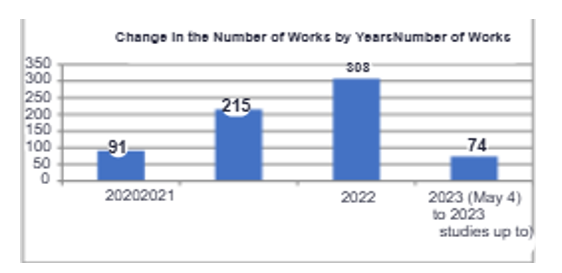
The first stage in the analysis of the data was related to the examination of the change in the number of studies on this subject over the years. Table 1 above shows the distribution of 688 studies with the phrase "European Green Deal" by years. An examination of Table 1 reveals that studies on this topic exhibit an increasing trend. This increase shows that the initiative has provided a new field of study for research and that the subject has started to come to the fore in the academic field with the increase in environmental problems.
Figure 1: Word cloud map on the European Green Deal
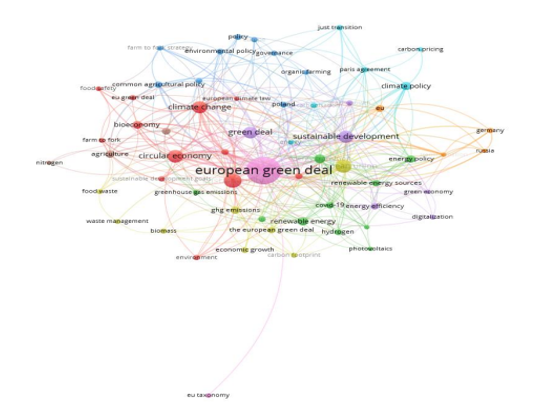
The second analysis is for keywords. Keywords are important in terms of showing which concepts a study will be shaped on. In other words, the subjects of the studies are primarily represented by keywords (Zeng, Li, Nuttapong, Sun, & Mao, 2022, p. 562). A total of 2444 different keywords were used in the academic studies included in the analysis. Figure 1 above shows keyword clusters and co-occurrence analysis of words. The size of the clusters refers to the frequency of the words used. In order to better reveal the connections between the expressions, the keywords used in at least five studies were visualized and as a result, 60 keywords were identified. "European Green Deal" has appeared 188 times, making it the most frequently used keyword. This was followed by sustainability (49 times), European Union (44 times), circular economy (41 times), climate change (39 times), sustainable development (37 times), Green Deal (36 times), energy transition (20 times), climate policy (18 times), renewable energy (17 times), bioeconomy (15 times), energy policy (14 times) and greenhouse gas emissions (14 times).
The keywords in Figure 1 are divided into 9 different color sets. The fact that the keyword clusters are the same color shows that these words are used together a lot. The closeness between the keywords indicates that these words tend to be in the same study (Yalçıntaşet al., 2023, p. 5). Furthermore, the keywords at the center of this network of relationships show that it has a wider range of relationships compared to those at the edges (Waltman, Eck, & Noyons, 2010, pp. 629–635). When the keywords are examined, it is revealed that the European Green Deal mainly focuses on two concepts. The first of these is the economy. The expressions used in the field of economics are based on circular economy, sustainable development and bioeconomy. The "EU taxonomy" (Güney and Saraç, 2022, p. 118), which is a classification system that supports green and sustainable economic activities and identifies environmentally compatible financial market instruments, is the keyword with the least connection with other keywords in the economy and the least frequency of use (6 times).
The effort to prevent climate change caused by high carbon emissions prompts the search for green energy sources (Brodny, Tutak, & Saki, 2020, p. 1). This situation is based on the academic field. The second most used concept within the scope of the agreement is related to energy issues. According to the wordcloud map, studies on energy are related to renewable energy sources and energy policies. The least addressed issue among the action plan presented by the agreement is related to agricultural strategy. When the usage rates of the keywords are examined, it is seen that the expressions agriculture (13 times), common agricultural policy (11 times), farm to fork strategy (6 times), food security (6 times), waste foods (6 times) and organic agriculture (6 times) are included less.
Figure 2: Countries that have done the most work on the European Green Deal
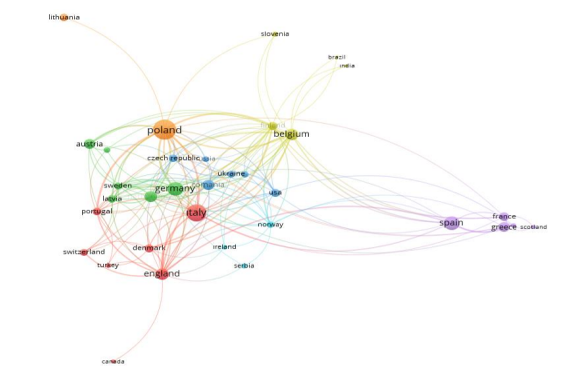
Another bibliometric analysis on the European Green Deal is the ranking of the countries that do the most work. Figure 2 shows the frequency and affiliations of academic work by country. According to the analysis, there are a total of 58 countries working on this issue. Among these 58 countries, the number of countries with at least three publications was determined as 44. Within the scope of the analysis, it is seen that Poland deals with this issue the most with 149 studies. The following countries are Italy (114 publications), Spain (72 publications), Germany (69 publications), England (52 publications), Belgium (49 publications), Netherlands (45 publications), Romania (41 publications), Austria (38 publications), Greece (36 publications), France (27 publications), America (26 publications), Denmark (25 publications), Finland (25 publications), Lithuania (23 publications), Czech Republic (22 publications), Norway (17 publications), Slovakia (15 publications), Russia (13 publications), Croatia (12 publications), Hungary (12 publications), Serbia (10 publications), Slovenia (10 publications) and Turkey (10 publications).
Within the EU, which aims to become a climate-neutral continent, Poland, Italy and Spain represent the countries with the highest academic interest in the subject. Poland produces the majority of its electricity from coal and is one of the largest producers of hard coal and lignite in the EU (Brauers and Oei, 2020, p. 1). In addition, before the announcement of the Memorandum, Poland had rhetoric of supporting the use of fossil fuels and stopping the emissions trading system to ensure energy supply security (Tusk, 2014). Therefore, the fact that there is a high interest in the issue of Reconciliation in academic studies from this country is meaningful in terms of evaluating the transformation in a scientific sense. As a matter of fact, Brauers and Oei (2020), one of the most cited studies, discussed the positive and negative aspects of this transformation for Poland and stated that Poland should follow the vision of the European Green Deal.
The links between the countries in Figure 2 show the citation relationship between academic studies. However, since the links do not point to a direction, the countries of the cited and cited authors are not identified. Therefore, the links indicate that there is a relationship between the studies. When these connections are examined, it is seen that Lithuania, India, Chile, Brazil, Canada, Slovenia and Scotland have citation relations with a small number of different countries. .Italy, Poland, Germany, Holland and England are the countries with the most citation links.
Table 2: Authors who have done the most work on the European Green Deal
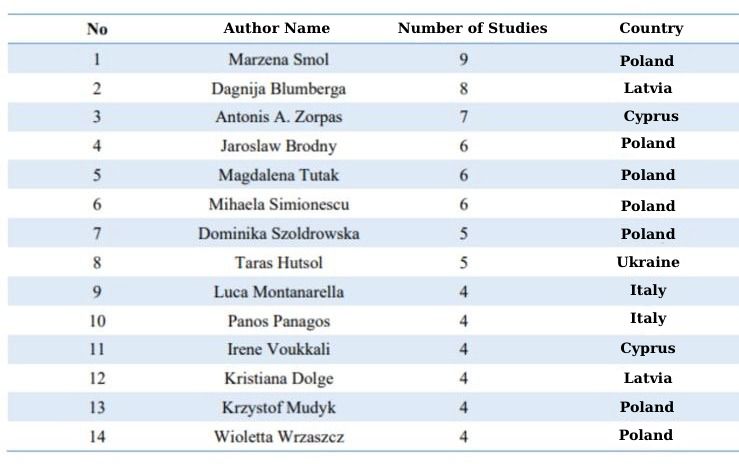
Author analysis is meaningful in terms of showing which authors researchers who will work in this field can turn to. Table 2 lists authors with at least four studies. When Table 2 is examined, it is seen that the people who have done the most work on the European Green Deal are Marzena Smol (9 studies), Dagnija Blumberga (8 studies) and Antonis A. Zorpas (7 studies). Considering that a total of 8 studies were carried out in Cyprus within the scope of the country analysis in Figure 2, it is revealed that 7 of them were conducted by Antonis A. Zorpas and 1 by Irene Voukkali. In addition, in Poland, which is the country with the most studies, it is seen that the prominent authors are Marzena Smol, Jaroslaw Brodny, Magdalena Tutak, Mihaela Simionescu, Dominika Szoldrowska, Krzystof Mudyk and Wioletta Wrzaszcz. In Latvia, where a total of 22 studies were included, 12 of the studies were carried out by Dagnija Blumberga and Kristiana Dolge. The striking point about the author analysis is that there are differences in the list of authors with the most studies shown in Table 2 and the most cited authors in Table 3.
Table 3: Most cited authors on the European Green Deal
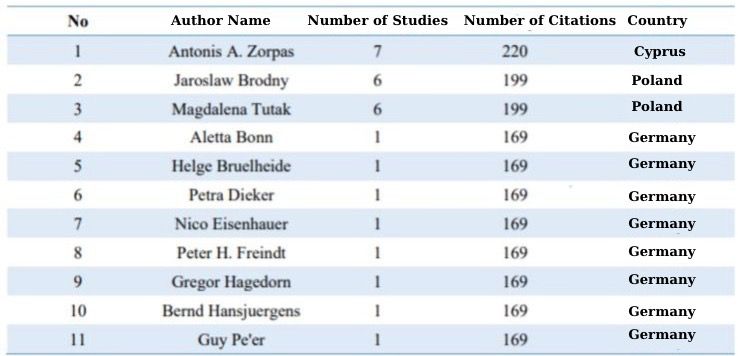
Table 3 lists the 11 most cited authors. When the most cited authors are examined, different names from Table 2 stand out. At this point, Antonis A. Zorpas (220 citations and 7 studies), Jaroslaw Brodny (199 citations and 6 studies), and Magdalena Tutak (199 citations and 6 studies) are the most cited authors, according to citation analysis. In addition, when Table 3 is examined within the scope of co-authorship analysis, it is seen that one of the most cited (169 cited) studies is a joint study conducted with different researchers. Figure 3 below reveals the connections between these co-authors more clearly.
Figure 3: Co-authorship analysis on the European Green Deal
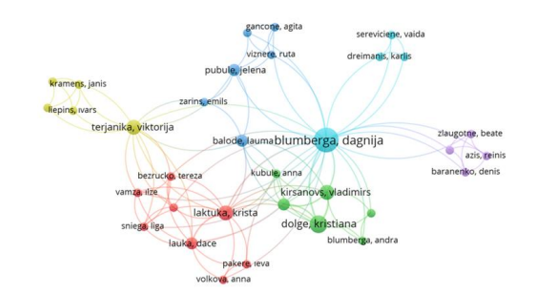
The interrelationships between authors in the literature are the main point discussed within the scope of co-authorship analysis. Figure 3 reveals the image of the co-authorship analysis on the European Green Deal. When Figure 3 is examined, it is seen that the author who is most open to cooperation in co-authorship is Dagnija Blumberga. In addition, it is seen that a total of 2344 researchers are working on this subject within the scope of the analysis. Considering that there are a total of 688 publications on this subject, it becomes clear that co-authorship on the subject of Reconciliation is widespread. It can be evaluated that this situation may be due to the fact that the European Green Deal is an interdisciplinary study subject.
Table 4: Most cited studies on the European Green Deal
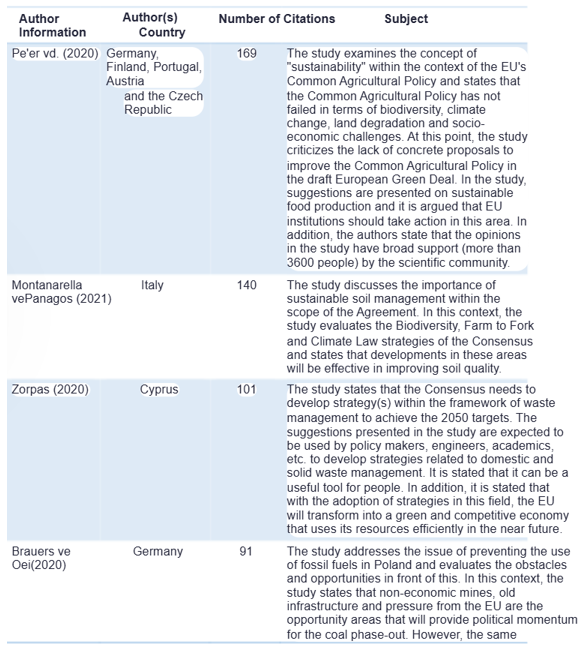
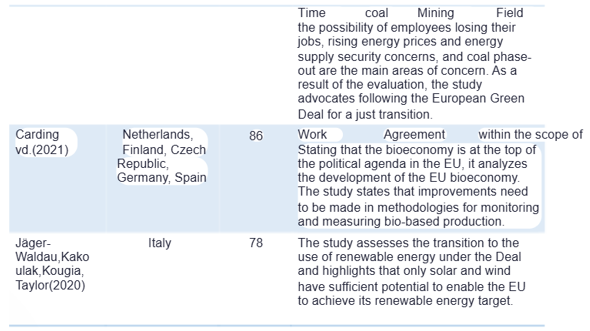
The information of the most cited studies is shown in Table 4. Examining the content of these studies is important in terms of showing the trend of the literature. When Table 4 is evaluated, it is seen that the two most cited studies are for the agricultural strategy of the European Green Deal. The keyword cloud in Figure 1, on the contrary, showed that the number of studies in the field of agriculture was less. Therefore, when these two most cited studies are compared with the keyword cloud, it is understood that the cited studies do not focus on the "agricultural strategy" area of the Consensus.
The study by Pe'er et al. (2020) draws attention to the lack of concrete proposals to improve the Common Agricultural Policy in the draft European Green Deal. Zorpas (2020) states that strategies should be developed within the framework of waste management. Kardung et al. (2021) focus on improving the field of bioeconomy. The common point of these three studies is that they point out that it would be beneficial to apply the knowledge they produce in the academic field in the field of policy. Thus, the studies address the limited points of the Consensus, indicate the areas that need improvement, offer suggestions on these issues and try to contribute to the development of the Consensus in general. This situation supports the fact that academic studies contribute to the development of the Consensus.
Table 5: Institutions that have done the most work on the European Green Deal
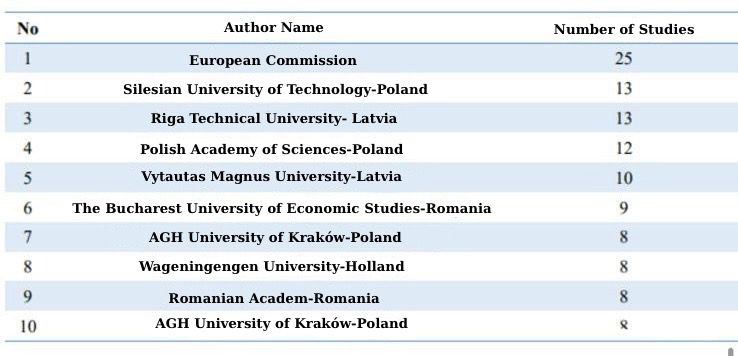
Finally, Table 5 lists the institutions that have done the most work on this subject. As a result of the analysis, it is seen that the most studies in this field are carried out by the European Commission, Silesian University of Technology (Poland) and Riga Technical University. The fact that the work is mostly carried out by the European Commission can be considered as the EU undertaking to ensure the dissemination of the Agreement. Among the institutions that carry out the most work, Poland stands out, which is the country that carries out the most work. However, Figure 2 shows that the other two countries that carry out the most studies are Italy and Spain, while the institutions in these countries are not included in Table 5. This means that research in Italy and Spain is carried out by different institutions.
CONCLUSİON
Considering the size and urgency of the impact area of environmental problems, it is important to take the necessary measures and raise awareness within the society. At this point, the European Green Deal, announced by the European Commission in 2019, has started a new process for the solution of environmental problems. Academic studies are important in developing consensus and increasing public awareness. At this point, the study evaluates the reflection of the EU's policy steps on academic studies with the bibliometric analysis method. The study visualized and interpreted 688 articles on the "European Green Deal" accessed from the WoS database and included in the SSCI, SCI and ESCI indexes with the VOSviewer mapping method.
As a result of the analysis, the study presents three main findings. First, the increase in the number of studies on the European Green Deal is expected to contribute to raising awareness of environmental security issues and to the further development of the Deal itself. In particular, it is seen that the analysis of the most cited studies draws attention to this situation and evaluates the areas that need improvement. Therefore, the information produced in the academic field is valuable in terms of being beneficial for the EU to reach its 2050 target. In addition, it is seen that the Commission both acts as the actor initiating and executing the initiative at the policy level and contributes to academic studies as the institution that carries out the most scientific publications.
Second, the word cloud map and the analysis of the most cited study reveal the strategies that are least and most addressed among the eight topics included in the action plan of the Reconciliation. Of the eight areas covered by the agreement, including climate, industry, energy, transportation, agriculture, biodiversity protection, zero pollution and a cleaner construction sector strategies, it is seen that the focus is mostly on industry/circular economy and energy. The field of agricultural strategy has little use, and it is stated that the Consensus needs to be developed in these uses. Transportation and construction strategies do not come to the fore within the scope of the analysis. The dissemination of academic studies on these strategies will be important in terms of evaluating the strengths and weaknesses of the Consensus in this field.
Finally, Poland, an EU member that deals with the European Green Deal issue the most in academic studies, is Poland. Therefore, Poland stands out among the authors with the most works. In this case, this country is the pioneer of the green transformation issue in the academic field. Apart from EU members, the countries that follow this transformation project the most are England, America, Norway, Russia, Serbia and Turkey. It is meaningful for countries other than EU members to follow this transformation in terms of trying to be a part of the solution in the global problem area. Therefore, it is expected that awareness will be high in these countries and these countries are expected to follow the EU in green transformation. However, another point that emerges is that China and India, which have high emission rates, do not follow the developments within the scope of the Agreement with academic studies. The support of these countries is also important for global cooperation.
It is thought that this study, which compiles the literature by providing a view of the trend of the field, will be useful for research on the European Green Deal. New bibliometric analysis studies may deal with different databases such as SCOPUS or JSTOR and different indexes in these databases. In addition, new studies to follow other scientific publications on environmental issues, the Carbon Border Mechanism or carbon leakage can make bibliometric analysis of the issues. Based on the analysis made in this research, future studies may contribute to the development of the Consensus in these areas, focusing on its strategies in agriculture, transportation and construction, which are less studied areas of the Consensus. At the same time, conducting a content analysis of the scientific publications produced in Poland—the country that stands out in the analysis—could reveal how the pre-Green Deal approach, which supported fossil fuels for energy supply security, has evolved following the implementation of the Deal. Similarly, it will be useful to examine the works of the authors who have carried out the most studies and received the most citations by content analysis method in order to see their evaluations within the scope of the Agreement.
YAZAR BEYANI / AUTHOR STATEMENT
The researcher(s) reported that they contributed to the article as a partner. The researcher(s) did not report any conflicts of interest.
BIBLIOGRAPHY
Abrizah, A., Zainab, A. N., Kiran, K., & Raj, R. G. (2013). LIS journals scientific impact and subject categorization: A comparison between web of science and scopus. Scientometrics, 94, 721-740. doi:10.1007/s11192-012-0813-7
Aını, P. & Görer-Tamer, N., (2021). Çevresel soylulaştırma üzerine bir bibliyometrik analiz. Black Sea Summit 7th International Applied Sciences Congress’te sunulan bildiri. Ordu, Türkiye.
Albayrak, G. (2023). Yeşil ekonomi alanında yazında yayınlanmış makalelerin bibliyometrik analizi. Dicle Üniversitesi Sosyal Bilimler Enstitüsü Dergisi, (32), 347-367.
Aşıcı, A. A. (2021). İktisadi düşüncede çevrenin yeri ve yeşil ekonomi: Karşılaştırmalı bir analiz. A. A. Aşıcı & Ü. Şahin (Ed.), Yeşil Ekonomi (s. 35-57) içinde. İstanbul: Yeni İnsan Yayınevi.
Avrupa Komisyonu. (2019). The European Green Deal. https://eur-lex.europa.eu/resource.html?uri=cellar:b828d165-1c22-11ea-8c1f-01aa75ed71a1.0002.02/DOC_1&format=PDF adresinden erişildi.
Bloomfield, J. & Steward, F. (2020). The politics of the Green New Deal. The Political Quarterly, 91(4), 770-779. doi: 10.1111/1467-923X.12917
Bogoslov, I. A., Lungu, A. E., Stoica, E. A., & Georgescu, M. R. (2022). European Green Deal impact on entrepreneurship and competition: A free market approach. Sustainability, 14(19): 1-15. doi: 10.3390/su141912335
Brauers, H., & Oei, P. Y. (2020). The political economy of coal in Poland: Drivers and barriers for a shift away from fossil fuels. Energy Policy, 144: 1-12. doi: 10.1016/j.enpol.2020.111621
Brodny, J., Tutak, M., & Saki, S. A. (2020). Forecasting the structure of energy production from renewable energy sources and biofuels in Poland. Energies, 13(10), 1-31. doi: 10.3390/en13102539
Çayırağası, F., & Sakıcı, Ş. (2021). Avrupa Yeşil Mutabakatı (Green Deal) ve Birleşmiş Milletler Sürdürülebilir Kalkınma Hedefleri perspektifinde sürdürülebilir dijital pazarlama stratejileri. Gaziantep University Journal of Social Sciences, 20(4), 1916-1937. doi: 10.21547/jss.930568
Çokişler, E. (2019). Uluslararası İlişkiler dergisinin bibliyometrik analizi (2004-2017). Uluslararası İlişkiler Dergisi, 16(64), 29-56. doi: 10.33458/uidergisi.652899
Ecer, K. Güner, O., & Çetin, M. (2021). Avrupa Yeşil Mutabakatı ve Türkiye ekonomisinin uyum politikaları. İşletme ve İktisat Çalışmaları Dergisi, 9(2), 125-144.
Friedman, T. L (2007). A warning from the garden. The New York Times.
https://www.nytimes.com/2007/01/19/opinion/19friedman.html adresinden erişildi.
Gevher, R., & Acet, H. (2023). Avrupa Birliğinde sürdürülebilir kalkınma ve yeşil ekonominin gelişimi. Anadolu Üniversitesi İktisadi ve İdari Bilimler Fakültesi Dergisi, 24(1), 224-253. doi: 10.53443/anadoluibfd.1184407
Gülmez, M., Oğuz, S. & Yalçıntaş, D. (2020). Sosyal inovasyon alanındaki yayınların görsel haritalama yöntemiyle bibliyometrik analizi. Süleyman Demirel Üniversitesi Vizyoner Dergisi, 11(Ek), 90-101. doi: 10.21076/vizyoner.727490
Güney, G., & Saraç, Ö. (2022). Assessments on the European Green Deal and EU taxonomy. Dokuz Eylül Üniversitesi Sosyal Bilimler Enstitüsü Dergisi, 24, 100-130. doi: 10.16953/deusosbil.1190923
Haydaroğlu, C. (2022). İktisat alanında göç konusunda yapılan lisansüstü tezlerin bibliyometrik analizi. Stratejik ve Sosyal Araştırmalar Dergisi, 6(2), 349-369. doi: 10.30692/sisad.1093130
İMSAD. (2021). Avrupa Yeşil Mutabakatı kapsamında "Fit for 55" paketi açıklandı.
https://www.imsad.org/Duyuru/avrupa-yesil-mutabakati-kapsaminda-fit-for-55-paketi-aciklandi adresinden erişildi.
Kakışım, C. (2022). Avrupa Yeşil Mutabakatı: Yeşil teori perspektifinden bir analiz. Stratejik ve Sosyal Araştırmalar Dergisi, 6(1), 1-16. doi: 10.30692/sisad.1064799
Kardung, M., Cingiz, K., Costenoble, O., Delahaye, R., Heijman, W., Lovrić, M., ... Zhu, B. X. (2021). Development of the circular bioeconomy: Drivers and indicators. Sustainability, 13(1), 413. doi: 10.3390/su13010413
Kurnaz, M. L. & Aksan-Kurnaz, I. (2022). Biyoekonomi, döngüsel ekonomi ve döngüsel biyoekonomi. Bilim ve Teknik, Ekim 2022.
Maretti, M., Tontodimamma, A., & Biermann, P. (2019). Environmental and climate migrations: An overview of scientific literature using a bibliometric analysis. International Review of Sociology, 29(2), 142-158. doi: 10.1080/03906701.2019.1641270.
Montanarella, L., & Panagos, P. (2021). The Relevance of sustainable soil management within the European Green Deal. Land Use Policy, 100, 104950. doi: 10.1016/j.landusepol.2020.104950.
Pe'er, G., Bonn, A., Bruelheide, H., Dieker, P., Eisenhauer, N., Feindt, P. H.,… Lakner, S. (2020). Action needed for the EU common agricultural policy to address sustainability challenges. People and Nature, 2(2), 305-316. doi: 10.1002/pan3.10080
Popescu, D. V., Dima, A., Radu, E., Dobrotă, E. M., & Dumitrache, V. M. (2022). Bibliometric Analysis of the Green Deal policies in the food chain. Amfiteatru Economic, 24(60), 410-428. doi: 10.24818/EA/2022/60/410
Rana, I. A. (2020). Disaster and climate change resilience: A bibliometric analysis. International Journal of Disaster Risk Reduction, 50: 1-16. doi: 10.1016/j.ijdrr.2020.101839
Reyes-Belmonte, M. A. (2021). The Energy and environment connection, research trends based on a bibliometric analysis. Energy, Ecology and Environment, 6(6), 479-495. doi: 10.1007/s40974-021-00220-7
Siddi, M. (2021). A green revolution? A tentative assessment of the European Green Deal. International Organisations Research Journal, 16(3): 85–107. doi:10.17323/1996-7845-2021-03-04.
Smol, M., Marcinek, P., Duda, J., & Szołdrowska, D. (2020). Importance of sustainable mineral resource management in implementing the circular economy (ce) model and the European Green Deal strategy. Resources, 9(5), 1-21. doi: 10.3390/resources9050055
Soylu, A. G., & Özkaya, F. D. (2021). İklim değişikliği ve gıda güvenliği konulu hakem denetimli makalelerin bibliyometrik profili. Türk Turizm Araştırmaları Dergisi, 5(2), 1589-1602. doi: 10.26677/TR1010.2021.782
Stern, N. (2007). The economics of climate change: The stern review. Cambridge: Cambridge University Press.
Sweileh, W. M. (2020). Bibliometric analysis of peer-reviewed literature on climate change and human health with an emphasis on infectious diseases. Globalization and Health, 16(1), 1-17. doi: 10.1186/s12992-020-00576-1.
Szpilko, D., & Ejdys, J. (2022). European Green Deal–research directions: A systematic literature review. Ekonomia i Środowisko, (2), 8-38. doi: 10.34659/eis.2022.81.2.455.
Tautiva, J. A., Huaman, J., & Ponce-Oliva, R. D. (2022). Trends in research on climate change and organizations: A bibliometric analysis (1999–2021). Management Review Quarterly, 1-35. doi: 10.1007/s11301-022-00298-1.
Tusk D. (2014). A united Europe can end russia’s energy stranglehold.” Financial Times.
https://www.ft.com/content/91508464-c661-11e3-ba0e-00144feabdc0 adresinden erişildi.
Waltman, L., Eck, N. J. & Noyons, E.C. (2010). A unified approach to mapping and clustering of bibliometric networks. Journal of Informetrics, 4, 629–635. doi: 10.1016/j.joi.2010.07.002.
Yalçıntaş, D., Oğuz, S., Yaşa-Özeltürkay, E., & Gülmez, M. (2023). Bibliometric analysis of studies on sustainable waste management. Sustainability, 15(2): 1-14. doi: 10.3390/su15021414.
Zeng, L., Li, R.Y.M., Nuttapong, J., Sun, J. & Mao, Y. (2022). Economic development and mountain tourism research from 2010 to 2020: Bibliometric analysis and science mapping approach. Sustainability, 14, 562. doi: 10.3390/su14010562.
Ziabina, Y., & Pimonenko, T. (2020). Green Deal policy for renewable energy: A bibliometric
analysis. Virtual Economics, 3(4), 147-168. doi: 10.34021/ve.2020.03.04(8).
Zorpas, A. A. (2020). Strategy development in the framework of waste management. Science of the Total Environment, 716, 137088. doi: 10.1016/j.scitotenv.2020.137088.
Zupic, I., & Čater, T. (2015). Bibliometric methods in management and organization. Organizational Research Methods, 18(3), 429-472. doi: 10.1177/1094428114562629.
Zyoud, S. H., & Fuchs-Hanusch, D. (2020). Mapping of climate change research in the Arab world: A bibliometric analysis. Environmental Science and Pollution Research, 27(3), 3523-3540. doi: 10.1007/s11356-019-07100-y
Arş.Gör.Özge Çetiner

Toplam Ziyaret: 36897 Bu Sayfaya Toplam Ziyaret: 45 Bugünlük Ziyaret: 55