

Determining the Factors that Affect University Students and Academicians’ Social Media Usage & Gratifications
Doç.Dr.Emre Kadir Özekenci tarafındanAbstract
 By the help of rapid developments in technology and new trends in social media platform, consumers’ behavior on digital platform has started to change. Users adopted a wide range of digital technologies into their communication. It remains unclear why they adopt multiple forms of social media instead of traditional media. In this context, the main purpose of this study investigates factors that affect university students and academicians being on social media, by the context of uses and gratification theory. In this context, data were collected from 345 university students and 87 academicians, by the technique of “easy sampling method”. Data management and analysis is performed by using SPSS 20.0 program. Results indicate that among the factors affecting the social media usage of the university students, there are differences between the genders in terms of the dimensions of socialization and obtaining information. In detail, the female participants are more satisfied than the female participants according to socializing and it is the vice versa for obtaining information. For academicians, there is a significant difference in terms of entertainment and information seeking dimensions, with the male participants having a higher average than the female participants.
Keywords: Uses And Gratification, Social Media, University Students And Academicians.
1. Introduction
Over the last decade, the social media has become one of the most popular vehicles facilitating a variety of communication and information-sharing tasks worldwide. Its growing popularity as a new medium of communication has resulted changes in the use of traditional media (Dimmick et al., 2004; Dunne and Lawlor, 2010). People are turning away from traditional media such as TV, radio, or magazines and are increasingly using social media to search for information (Mangold and Faulds, 2009). Due to the increasing popularity of social media user, personal social interaction with friends, family and professional contacts has transformed itself from the offline realm into an online entity. (Gallion, 2014) Therefore, active users of social media present themselves, develop and maintain relationships with others (Ellison et al., 2007) Facebook, Instagram, Youtube, Twitter and LinkedIn are successful examples. (Hanson and Haridakis, 2008; Johnson and Yang, 2009; Chen, 2011; Nadkarni and Hofmann, 2012; Florenthal, 2015; Özelturkay and Yarımoğlu, 2017) For example, Facebook report that there are over 2,07 billion monthly active Facebook users for Q3 2017 which is a 16 percent increase year over year (Statista. com, 2018a; Zephoria.com, 2018). And Instagram had reached 800 million monthly active users in September 2017, up from 600 million in December 2016 (Statista. com, 2018b). The data shows that social media is increasingly becoming a focal topic in the communication arena. The growing popularity of the using social media as a new medium of communication has resulted in changes in people’s daily lives, as well as in their use of traditional media. An example of such changes lies in the way people obtain news. (Dimmick et al., 2004).
2. Background:
Uses and Gratification Theory We will now define uses and gratification theory and discuss its relevant to social media. Then, we will examine previous studies which are investigated in Turkey and in the rest of the World.
2.1. The Uses and Gratification Theory
Uses and gratifications research was developed based on social and psychological origins of needs which generate expectations of the media. The theory explains that people have differential patterns of media exposure resulting in need gratifications Uses and gratifications focus on individual choices. People choose among available communication or functional alternatives. They make their choices based on their wants, interests, and expectations. These choices affect the process and outcomes of communication. (Katz et al., 1974) To understand communication process and outcomes, we need to understand people’s background motives, and involvement (Rosengren, 1974). In particular, people are variably motivated and involved when they communicate.
2.2. Uses and Gratifications Theory and Social Media
Uses and gratifications theory is relevant to social media, because of its origins in the communications literature. Social media is a communication mechanism that allows users to communicate with thousands, and perhaps billions of individuals all over the World (Williams et al., 2012).
A basic assumption of the uses and gratification theory is that people are actively involved in social media usage and interact highly with the communication media by building profile groupings of related uses and theoretically associated gratifications (Luo, 2002). Social media is published, created and shared by individuals on the internet such as blogs, images, and videos and more (Chung and Austria, 2010). Current examples of social media platforms include social networking sites like Facebook, photo sharing sites like Instagram, business networking sites like Lİnkedin, video sharing sites like YouTube, micro blogging sites like Twitter, and numerous others (Whiting and Williams, 2013).
The social network profile is the focal point of one’s social networking existence. Each profile page is unique to the owner, each member is encouraged to upload their personal photographs and share range of personal information such as where they work or where they go to school and details about their personal tastes such as favorite places to eat, favorite book etc.. (Boyd, 2007) Friends also play a fundamental role in the composition of social networking sites. Profiles offer a facility for communication and interaction between users, usually in the form of a comment section (Lawlor and Rowley, 2010).
What motivates them to start using social media and why they continue to use them? Mass communication researchers are using the uses and gratifications theory to provide an explanation as to why users find this new form of media to be so enticing. The theory describes why people use a particular medium and what functions the medium serves for them (Karimi et al., 2014).
2.3. Cross Country Uses and Gratification Theory Research
Because of the high development in digital platforms, there has been an increasing interest in social media. Therefore, in the new global economy, social media has become a central issue for businesses and manufacturers. Thus, the importance of users and gratification theory has increased significantly as each day passes. Therefore, a considerable amount of literature has been published on users and gratification theory by many researchers. In this part, previous and current studies are investigated and these studies are categorized into two groups; users and gratification theory in Turkey and in the rest of the World.
2.3.1. Uses and Gratification Studies in Turkey
Toruk (2008) investigated three popular media tools used by university students and media usage habits of university students within the uses and gratification theory. Survey was applied to 205 university students to elicit information. This study explained that income level and gender differences played important role on media usage habits.
Küçükkurt et al (2009) investigated university students’ view of media with the uses and gratification approach. Data were collected from various universities located in Ankara. These variables are measured through survey questionnaire distributed among a sample of 2031 university students. The results showed that most university students follow the media through television, internet and newspaper and they use the media mostly to satisfy their emotional needs.
Ayhan and Balcı (2009) analyzed the internet usage habits and motivation of university students with the uses and gratification theory. Data was collected from four different universities in Bıshkek. These variables are tested through survey distributed among a sample of 308 university students. The results indicated that there are four major factors in internet usage and motivation. These are shown as; interaction, social escape, economic benefit and entertainment.
Akçay (2011) identified social media use with the context of uses and gratification theory. The basic aim of this study was explored how the students, academic and administrative personnel use internet and what their goals of using internet are. The study was conducted in the form of a survey, with data being gathered via students, academic and administrative personnel in Gümüşhane University. The results of this study indicate that social interaction, entertainment and relaxation were significant factors for people being on social media.
Köseoğlu (2012) identified the kind of factors motivating university students’ being online on Facebook. The data was obtained from two-stage approach; exploratory and scale stage. The results have shown that easy to use, sharing video/photography, follow the agenda, magazine issues, social interaction were major factors on social media motivators.
Biçer (2014) examined the motivation of academicians being on Facebook by using the uses and gratification theory. The basic questions were why academicians exist on Facebook and what kinds of differences are present for them compared to the other users. Data were gathered by multiple methods; face to face in depth interviews and Wolfram Alpha application. Researcher observed that main motivations of academicians being on Facebook as follows; communication with other academicians and followers, visibility in academic area and perform daily activities over this platform. On the other hand, academicians do not use Facebook to make new friends.
Çam et al. (2014) examined the factors that affect the motivation of university students of social media tools within the context of uses and gratification theory. Data were collected through survey questionnaire distributed among 156 university students. The results indicated that information-seeking, solving problem, connectivity and content management were significant effects on social media usage.
Üçer (2016) examined that why university students use the social media by applying the uses and gratification theory. Researcher collected data from Yeditepe University by making focus group interview. Research focus on only some social media tools; Facebook, Instagram and Twitter. The findings showed that, the popularity of Facebook and Twitter has decreased among students. Students use the Facebook, Twitter and Instagram to make social interaction, reach news and knowledge, and entertainment.
Kara (2016) aims to investigate why university students use the Snapcat in the context of uses and gratification theory. Focus group interviews were conducted within Marmara University students about Snapchat usage reasons and preferences. He found that entertainment and spend free time are major factors in the usage of Snapchat. Also, increase in popularity of Snapchat application among university students and rich visualization features are other two important factors increasing the usage of Snapchat.
Özer (2017) investigated the twitter usage within the context of uses and gratification theory in this study. Researcher tried to figure out why students in Eskişehir Osmangazi University use the Twitter. For this purpose, survey was conducted within the students at Osmangazi University. The findings explain that most participants know the Twitter and how to use it, almost all of the participants have Twitter account, participants have been using Twitter approximately for four years, and most participants have been using smartphone and tablet to connect Twitter. Also, participants use Twitter for following things; entertainment, to follow the agenda and reading others’ tweets.
2.3.2. Uses and Gratification Studies in the World
Park et al (2009) investigated Facebook group’s users’ gratifications and the relationship between users’ gratifications and their political and civic participation offline. Data were gathered from 1715 college students. The findings indicated that basic needs for the college students within Facebook are entertainment, information, socializing and self-status seeking.
Urista et al. (2009) investigated through focus groups why young adults use social network sites within the context of using and gratification theory. The findings show that young adults use social networks mainly for entertainment and information.
Hicks et al. (2012) explored why individuals use the Yelp.com within the context of uses and gratification theory. Data were gathered from online survey questionnaire. The findings of the study show that individuals use mainly Yelp.com for the following things; information seeking, interpersonal utility, entertainment and free time activity.
Whiting and Williams (2013) examined the importance of uses and gratification theory on social network sites. Data were obtained from in-depth interviews. The result of the study indicates that people use social media for information sharing, knowledge about others, social interaction, pass time, information seeking, relaxation, and entertainment and communicatory utility.
The main goals of Froget et al. (2013) to examine the major motivators of Facebook use in Mauritius and to assess Facebook intensity based on socio-demographic background of the respondents. Data were collected through an online survey questionnaire. The result indicates that level of income was the significant factor in the Facebook use among people. In other words, there was a significant difference of Facebook use between groups of different income levels.
The main goal of Ezumah (2013) was to explain what factors influence college students’ preference of one social media tool over others. For this purpose, data were obtained through survey questionnaire. The findings of this study demonstrated that keeping in touch with friends/family, sharing photos and entertainment were significant factors for the college students being on social media.
Tanta et al. (2014) explored the benefits of Facebook use among the young people by using uses and gratification theory. The major question of this study was why young people use Facebook. Researcher applied a survey questionnaire for approximately 450 young people in the city of Zagreb. The results showed that most young people use Facebook for the following things; socializing, communicating and dates with their friends, and discussing school activities.
Musa et al. (2015) explained what people do with the social media within the context of uses and gratification theory. Interview and survey was conducted to elicit information from final year students of mass communication. The findings indicated that people used social media for research, communication, making friends, and news sharing and maintaining connection.
As we can see from the above, the number of studies regarding social media has been increasing within the context of uses and gratification framework. Taken as a whole, the current and previous research on users and gratification clearly shows that people use the internet and social media tools to satisfy their specific needs. Individuals generally use the social media for satisfying entertainment needs, interpersonal needs, informational needs, socializing needs and more. However, there is limited research on academicians’ behavior on social media (Akçay, 2011; Biçer, 2014). Based on limited number of previous research findings, we are hoping to find that this study might provide useful information to explain why the academicians are using social media and the differences between the college students and the academicians.
3. Methodology
3.1. The Purpose of This Study
The purpose of this study was to investigate the reason of social media usage and gratification among the university students and the academicians in the accordance to social-demographical factors.
3.2. Participants
Data were collected by using the easy sampling method in this study, from 485 participants who were students and academicians of a private university in Mersin. 345 questionnaires were validated for further analysis out of 397 university students’ data and 87 fully completed questionnaires out of 88 from academicians’ were finally included in the analysis.
3.3. Measures
After receiving permission from the University Rectorate for the application of questionnaires, a paper-based survey was used in this study for data collection. The questionnaire comprised two sections: First, demographic information form consisting of a series of demographic questions, second, social media uses and gratifications scale including the questions measuring one’s gratifications for using social media. Data were analyzed with SPSS 20.0.
3.4. Demographic Information Form
Two separate demographic information forms were used by the researchers. For the university students, the demographic information form included questions about gender, age, marital status, connection tools, using time in social media, duration of using media actively, aims of using social media and which medias were used mostly to get information. For academicians, the same questions were used with the academicals titles inserted.
3.5. Social Media Uses and Gratifications Scale
To measure the gratifications for social media usage, 14 items were included in the questionnaire. The items were pooled from previous U&G studies (Park, Kee& Valenzuela, 2009). A 6 point Likert scale ranging from strongly agree= (1) to strongly disagree= (6) was used, comprised from socializing (5 items), entertainment (3 items), self-status seeking (3 items), information seeking (3 items) sub-factors. We adapted the scale to Turkish language using all the four sub-factors. Our adaptation included 4 items for socializing, 4 items for entertainment, 2items for self-status seeking, 4 items for information seeking sub-factors. The sums of the scores of the items in each sub-factor were calculated to be the scores of the sub-factors.
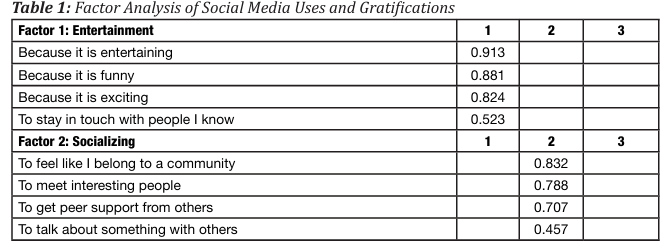
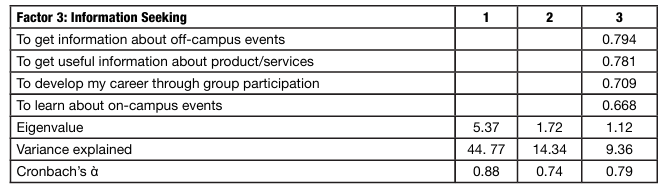
Principal component analysis followed by Oblimin rotation allows an investigation of dimensionality of the gratifications. Exploratory factorial analyses revealed three factor solution with an eigenvalue above 1 and factor loadings greater than 0.3. These four factors explained 68.48 % of the total variance. Detailed measures of constructs are presented in Table 1. The Kaiser-Mayer-Olkin (KMO) was 0.87 and the Barlettsphericity test was 0.66 (p<0.001). These values showed that, data obtained from pre-implementation were convenient for factor analysis. Kaiser-Meyer-Olkin value of the scale was above 0.60, which was in the acceptable range (Büyüköztürk, 2010).
Factor 1 was labeled as Entertainment. It contained four items (“Because it is entertaining”, “Because it is funny”, “Because it is exciting” and “To stay in touch with people I know”) and accounted for 44.77% of the total variance after rotation.
Factor 2, Socializing, contained four items (“To feel like I belong to a community”, “To meet interesting people”, to get peer support from others” and “To talk about something with others”) and accounted for 14.34% of the total variance.
Factor 3, Information seeking, consisted of four items (“To get information about off-campus events”, “To get useful information about product/services”, “To develop my career through group participation” and “To learn about on-campus events”) and explained 9.36% of the total variance.
In the present study, all the three factors were found highly reliable measurements with Cronbach’s Alpha reliability; Entertainment (ὰ=0.88), Socializing (ὰ=0.74), Information seeking (ὰ=0.79). However, Self-status seeking factor was found to be low with Cronbach’s Alpha reliability as 0.37. Therefore, self-status seeking sub-factor was discarded from the analysis. This indicates an acceptable internal consistency for three dimensions of the scale except one dimension, self-status seeking. According to Büyüköztürk (2010), the acceptable values of alpha are ranging from 0.60 to 0.80.
4. Results
In order to investigate the difference between the categorical variables of two levels, t-test was used and one way ANOVA is used to determine whether there were statistically significant differences between the means of three or more independent groups. These results were as follows.
4.1. Descriptive Statistics
Descriptive statistics were produced for all variables. Findings showed that 57 (65.5%) academicians were female out of a total number 87. The majority of the academicians were in the age range 25-35 (52.9%). 48 (55.2%) academicians were single, 27 (%31.0) academicians were instructors, 69 (79.3%) academicians connected the social media by using mobile, 47 (%54.0) academicians used Instagram, 73 (%83.9) academicians used social media for getting information, 76 (%87.4) academicians have the social media accounts over 5 years and 47 (%54.0) academicians used social media actively between 1 and 5 hours a day. Data according university students; 201 (58.3%) university students were female out of a total number 345. The majority of university students were in the age range of 18 24 (85.5%). 326 (%94.5) university students were single, 332 (96.2 %) university students connected the social media by using mobile, 255 (%79.9) university students used Instagram, 200 (%58.0) university students used social media for spending time, 239 (%69.3) university students had social media accounts over 5 years and 215 (%62.3) university students used social media actively between 1 and 5 hours a day.
4.2. Inferential Statistics
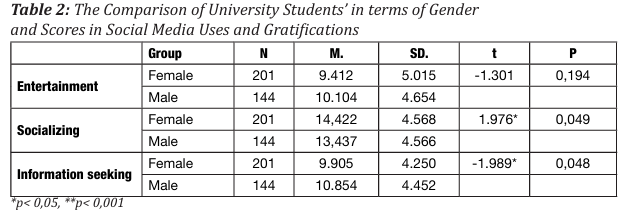
When we examined the possible differences according to the gender, T test results in Table 2 showed that there was no statistically significant difference among university students’ scores from the entertainment (p=0,194; p>0,05) whereas there was a statistically significant difference among their scores from the socializing (t=1.976; p=0,049; p<0,05) and information seeking (t= -1.989; p=0,048; p<0,05) sub-factors of social media uses and gratifications according to their gender. It was observed that socializing mean scores of the female university students (14.422 ± 4.568) were significantly higher than the male university students (13.437 ± 4.566), conversely, information seeking mean scores of the male university students (10.854 ± 4.452) were higher than the female university students (9.905 ± 4.250).
ANOVA results in Table 3 showed that there was a statistically significant difference among university students’ scores from the entertainment (F=5.200; p=0,006; p0,05) according to their duration of using social media actively. Post Hoc test comparison with Games-Howell showed that the entertainment mean scores of the university students who used social media less than one hour a day (11.782 ± 3.614) were significantly higher than the university students who used between one and five hours a day. (9.260 ± 4.348). Similarly Post Hoc test comparison with Games-Howell showed that the entertainment mean scores of the university students who used social media less than one hour a day (11.782 ± 3.614) were significantly higher than university students who used social media more than five hours a day (9.690 ± 6.297). In addition, Post Hoc test comparison with Games-Howell showed that socializing mean scores of the university students who used social media less than one hour a day (16.087 ± 5.290) were significantly higher than the university students who used between one and five hours a day. (13.423 ± 4.089).

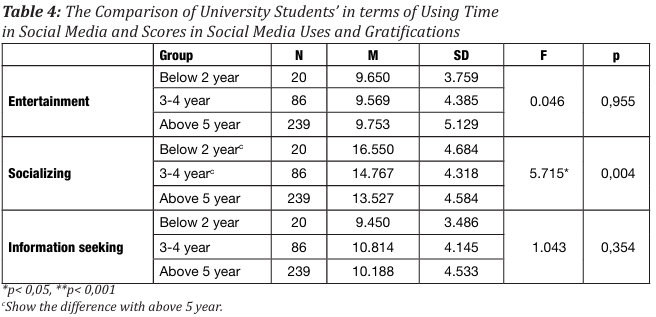
ANOVA results in Table 4 showed that there was a statistically significant difference among the university students’ scores only from the socializing (F=5.715; p=0,004; p0,05) and information seeking sub-scales (p=0,354; p>0,05) according to their duration of using social media. Post Hoc test comparison with LSD showed that socializing mean scores of the university students who used social media less than two years (16.550 ± 4.684) were significantly higher than the university students who used more than five years (13.527 ± 4.584). Similarly Post Hoc test comparison with LSD showed that socializing mean scores of the university students who used social media between three and four years (14.767 ± 4.318) were significantly higher than the university students who used more than five years (13.527 ± 4.584).
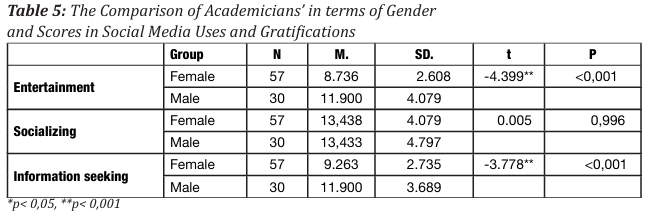
T test results in Table 5 showed that there was a statistically significant difference among academicians’ scores from the entertainment (t= -4.399; p<0,001) and information seeking (t=0.005; p<0,001) sub-factors whereas there was no statistically significant difference among their scores from the socializing (p=0,996>0.05) sub factors of social media uses and gratifications according to their gender. It was observed that the entertainment mean scores of the male academicians (11.900 ± 8.736) were significantly higher than the female academicians (8.736 ± 2.608), in addition, information seeking mean scores of the male academicians (11.900 ± 3.689) were higher than the female academicians (9.263 ± 2.735).
There was no statistical significant difference among the university students’ and the academicians’ scores from the entertainment, socializing and information seeking sub factors of social media and gratifications according to their age, marital status and connection tools. The p-values for the entertainment scores according to age are p=0,873 (p>0,05) and p=0,084 (p>0,05) respectively for the university students and the academicians. The p-values for the socializing scores according to age are p=0,568 (p>0,05) and p=0,905 (p>0,05) respectively for the university students and the academicians. Those for the information seeking scores are p=0,952 (p>0.05) and p=0,558 (p>0,05) again respectively for the university students and the academicians. The p-values for the entertainment scores according to the marital status are p=0,206 (p>0,05) and p=0,084 (p>0,05) respectively for the university students and the academicians. The p-values for the socializing scores according to the marital status are p=0,276 (p>0,05) and p=0,730 (p>0,05) respectively for the university students and the academicians. The p-values for the information seeking scores according to the connection tools are p=0,819 (p>0,05) and p=0,646 (p>0,05) respectively for the university students and the academicians. The p-values for the entertainment seeking scores according to the connection tools are p=0,424 (p>0,05) and p=0,343 (p>0,05) respectively for the university students and the academicians. The p-values for the socializing seeking scores according to the connection tools are p=0,054 (p>0,05) and p=0,835 (p>0,05) respectively for the university students and the academicians. The p-values for the information seeking scores according to the connection tools are p=0,300 (p>0,05) and p=0,056 (p>0,05) respectively for the university students and the academicians. Similarly, there was no statistical difference among the academicians’ scores from the entertainment, socializing and information seeking sub factors of social media and gratifications according to the duration of using social media actively and using time in social media. The p-values for the duration of using social media actively are p=0,178 (p>0,05), p=0,975 (p>0,05) and p=0,178 (p>0,05) respectively according to the entertainment scores, the socializing scores and the information seeking. Those for using time in social media are p=0,186 (p>0,05), p=0,309 (p>0,05) and p=0,469 (p>0,05) again respectively according to the entertainment scores, the socializing scores and the information seeking.
5. Conclusion
In recent days, the social media has become very important among the researchers by the help of the technological development. The number of users in social media has continued to increase enormously since the beginning of the 2000s. Therefore, it is not surprising that numerous studies have attempted to explain the reason why people are on social media. Thus, the major objective of this study was to investigate the reason why the university students and the academicians are on social media, by the context of uses and gratification theory. Data management and analysis were performed using SPSS 20.0 program. ANOVA and T-test were used to find the factors affecting the reasons why the university students and the academicians are on social media. The study was conducted in the form of a survey, with data being gathered via university students and academicians in Çağ University. By the end of the survey period, data were collected from 345 university students and 87 academicians. The study consists of six sections. The study starts with the introduction section which is followed by the literature section, the methodology section and the conclusion section. The final section includes the limitations and suggestions. The revealed results enable us to make some comparisons between the university students and the academicians in the field of determining of the factors affecting them for being online in social networks.
The results of this study indicate that the students and the academicians generally use social media tools for entertainment, socializing and obtaining information from their social environment. The use of social media tools primarily students’ need for socializing, entertainment and understanding of their social environment, which is consistent with Ayhan and Balcı, (2009); Park et al, (2009); Urista et al, (2009); Akçay, (2011); Köseoğlu, (2012); Hicks et al, (2012); Whiting and Williams, (2013); Ezumah, (2013); Çam et al, (2014); Tanta et al, (2014); Musa et al, (2015); Üçer, (2016); Kara, (2016); Özer, (2017). Since most of the students are in the age interval 18-24 and single, there is no big differences between them in terms of age and marital status.
A gender difference is one of the important factors in socialization sub-dimension for both university students and academicians. The female students are more pleased to use social media tools for socializing whereas the male students are more satisfied to use social media tools for obtaining information. Similar to the male students, the male academicians are more satisfied to use social media for obtaining information. Different from the university students, the male academicians are more satisfied than the female academicians to use social media for entertainment.
Active usage rate of social media tools is another significant factor. As the rate of active usage rate increases, pleasures of students decrease. For example, the students who are using social media less than one hour are more satisfied compared to the other students who are using social media between one and five hours. This result can be explained as follows; when the time period is gets longer, the students might be bored and tired of being online in social media.
Overall, these results indicate that obtaining information, socializing and entertainment are important factors for both university students and academicians’ satisfaction and being in social media. This result is quite acceptable and supported by the previous study; Akçay (2011) and Biçer (2014).
6. Limitations and Suggestions
This study provides an important opportunity to advance the understanding the reason why university students and academicians are online in social media and the factors affecting their being in social media. Therefore, this research will contribute the future studies in this area. However, this study includes several limitations. The major limitation of this study is the small sample size. Further research should be done to investigate this subject with much more university students and academicians in a different location. Therefore, it is recommended that the results would be validated through a larger scale sample using a multiple method.
References
Akçay, H. (2011). Kullanımlar ve Doyumlar Yaklaşımı Bağlamında Sosyal Media Kullanımı: Gümüşhane Üniversitesi üzerine bir araştırma, İletişim Kuram ve Araştırma Dergisi, 33, 137-161.
Ayhan, B. and Balcı, Ş. (2009). Kırgızistan’da Üniversite Gençliği ve Internet: Bir Kullanımlar ve Doyumlar Araştırması. Bilig Journal of Social Sciences of the Turkish World, 48, 13-40.
Biçer, S. (2015). Akademisyenlerin Sosyal Ağlarda Bulunma Motivasyonları: Facebook Örneği, Dumlupınar Üniversitesi Sosyal Bilimler Dergisi, 40, 59-80
Boyd, D. (2007). Why Youth (Heart) Social Network Sites: The Role of Networked Publics İn Teenage Social Life, pp.1-26, (Ed.) Buckingham D., Macarthur Foundation Series on Digital Learning–Youth, İdentity And Digital Media Volume, MIT Press, Cambridge.
Büyüköztürk, Ş. (2010). Sosyal Bilimler için Veri Analizi El Kitabı, Pegem Akademi Yayıncılık, Ankara
Çam, M. S., Çakmak, V. and Aktan, E. (2014). Üniversite Öğrencilerinin Sosyal Medya Kullanımlarını Etkileyen Motivasyon Faktörleri, Digital Communication Impact, 377-388
Chen, G. M. (2011). Tweet This: A Uses and Gratifications Perspective on How Active Twitter Use Gratifies A Need to Connect with Others, Computers in Human Behavior, 27(2), 755-762.
Chung, C. and Austria, K. (2010). Social Media Gratification and Attitude toward Social Media Marketing Messages: A Study of the Effect of Social Media Marketing Messages on Online Shopping Value, Proceedings of the Northeast Business & Economics Association, 581-586
Dimmick, J., Chen, Y. and Li, Z. (2004). Competition Between the Internet and Traditional News Media: The Gratification-Opportunities Niche Dimension, the Journal of Media Economics, 17(1), 19-33.
Dunne, Á., Lawlor, M. A., and Rowley, J. (2010). Young People’s Use of Online Social Networking Sites–A Uses and Gratifications Perspective, Journal of Research in Interactive Marketing, 4(1), 46-58.
Ellison, N. B., Steinfield, C. and Lampe, C. (2007). The Benefits of Facebook “Friends:” Social Capital and College Students’ Use of Online Social Network Sites. Journal of Computer-Mediated Communication, 12(4), 1143-1168.
Ezumah, B. A. (2013). College Students’ Use of Social Media: Site Preferences, Uses and Gratifications Theory Revisited, International Journal of Business and Social Science, 4(5), 27-34.
Florenthal, B. (2015). Applying Uses and Gratifications Theory to Students’ Linkedın Usage”, Young Consumers, 16(1), 17-35.
Froget, J. R. L., Baghestan, A. G., and Asfaranjan, Y. S. (2013). A Uses and Gratification Perspective on Social Media Usage and Online Marketing, Middle-East Journal of Scientific Research, 15(1), 134-145.
Gallion, A. J. (2014). Applying the Uses and Gratification Theory to Social Networking Sites, 1-19.
Hanson, G. and Haridakis, P. (2008). YouTube Users Watching and Sharing the News: A Uses and Gratifications Approach, Journal of Electronic Publishing, 11(3).
Hicks, A., Horovitz, J., Hovarter, M., Miki, M. and Bevan, J. L. (2012). Why People Use Yelp. Com: An Exploration of Uses and Gratifications, Computers in Human Behavior, 28(6), 2274-2279.
Johnson, P. R. and Yang, S. (2009). Uses and Gratifications of Twitter: An Examination of User Motives and Satisfaction of Twitter Use. In Communication Technology Division of the Annual Convention of the Association for Education in Journalism and Mass Communication İn Boston, Ma.
Kara, T. (2016). Gençler Neden Snapchat Kullanıyor, Kullanımlar ve Doyumlar Yaklaşımı Üzerinden Bir Araştırma. International Journal of Intermedia, 3(5), 262-277.
Karimi, L., Khodabandelou, R., Ehsani, M. and Ahmad, M. (2014). Applying the Uses and Gratifications Theory to Compare Higher Education Students’ Motivation for Using Social Networking Sites: Experiences from Iran, Malaysia, United Kingdom, And South Africa, Contemporary Educational Technology, 5(1), 53-72.
Katz, E. (1974). Utilization of Mass Communication by The Individual. The Uses of Mass Communications: Current Perspectives on Gratifications Research, 19-32.
Köseoğlu, Ö. (2012). Sosyal Ağ Sitesi Kullanıcılarının Motivasyonları: Facebook Üzerine Bir Araştırma, Selçuk Üniversitesi İletişim Fakültesi Akademik Dergisi, 7(2), 58-81.
Küçükkurt, M., Hazar, Ç. M., Çetin, M. and Topbaş, H. (2009). Kullanımlar ve Doyumlar Yaklaşımı Perspektifinden Üniversite Öğrencilerinin Medyaya Bakışı, Selçuk Üniversitesi İletişim Fakültesi Akademik Dergisi, 6(1), 37-50.
Luo, X. (2002). Uses and Gratifications Theory and E-Consumer Behaviors: A Structural Equation Modeling Study, Journal of Interactive Advertising, 2(2), 34-41.
Mangold, W. G. and Faulds, D. J. (2009). Social Media: The New Hybrid Element of the Promotion Mix. Business Horizons, 52(4), 357-365.
Musa, A. S., Azmi, M. N. L. and Ismail, N. S. (2015). Awareness and usage of social media: a study of mass communication students of Kano state polytechnic, In International Conference on Languages| ICL 2015 Kuala Lumpur, 15
Nadkarni, A. and Hofmann, S. G. (2012). Why Do People Use Facebook? Personality and İndividual Differences, 52(3), 243-249.
Özer, Ö. (2017). Kullanımlar ve Doyumlar Kuramı Çerçevesinde Eskişehir Osmangazi Üniversitesi İi Bf Öğrencilerinin Twitter Kullanımı Üzerine BirAnaliz, Intermedia International Peer-Reviewed E-Journal of Communication Sciences, 4(6), 40-58.
Park, N., Kee, K. F. and Valenzuela, S. (2009). Being İmmersed in Social Networking Environment: Facebook Groups, Uses and Gratifications, And Social Outcomes, Cyberpsychology & Behavior, 12(6), 729-733.
Rosengren, K. E. (1974). Uses and Gratifications: A Paradigm Outlined, the Uses of Mass Communications: Current Perspectives on Gratifications Research, 3, 269-286.
Statista (2018a), Number of Monthly Active Facebook Users Worldwide, Retrieved from: https://www.statista.com/statistics/264810/number-of-monthly-active-facebook-users-worldwide, 18.01. 2018
Statista (2018b), Number of Monthly Active Instagram Users, Retrieved from: https://www.statista.com/statistics/253577/number-of-monthly-active-instagram-users/21.01.2018
Tanta, I., Mihovilović, M. and Sablić, Z. (2014). Uses and Gratification Theory–Why Adolescents Use Facebook? Medijskaİstraživanja: Znanstveno-Stručni Časopis ZaNovinarstvo İ Medije, 20(2), 85-111.
Toruk, İ. (2008). Üniversite Gençliğinin Medya Kullanma Alışkanlıkları Üzerine Bir Analiz. Selçuk Üniversitesi Sosyal Bilimler Enstitüsü Dergisi, (19), 475-488.
Üçer, N. (2016). Kullanımlar Ve Doyumlar Yaklaşımı Bağlamında Gençlerin Sosyal Media Kullanımına Yönelik Niteliksel Bir Araştırma, Global Media Journal Turkish Edition, 6(12), 1-26
Urista, M. A., Dong, Q. and Day, K. D. (2009). Explaining Why Young Adults Use Myspace and Facebook through Uses and Gratifications Theory, Human Communication, 12(2):215-229.
Whiting, A. and Williams, D. (2013). Why People Use Social Media: A Uses and Gratifications Approach. Qualitative Market Research, An International Journal, 16(4), 362-369.
Williams, D. L., Crittenden, V. L., Keo, T. and Mccarty, P. (2012). The Use of Social Media: An Exploratory Study of Usage among Digital Natives, Journal of Public Affairs, 12(2), 127-136.
Yaşa Özeltürkay, E, and Yarimoğlu,E, (2017). How and Why Consumers Use Social Media: A Qualitative Study Based on User-Generated Media and Uses & Gratifications Theory, 22. Pazarlama Kongresi, Trabzon 28-30 Eylül 2017.
Zephoria (2018), Top-15-valuable-facebook-statistics, Retrieved from: https:// zephoria.com/top-15-valuable-facebook-statistics/, 18.01.201
Doç.Dr.Emre Kadir Özekenci

Toplam Ziyaret: 61063 Bu Sayfaya Toplam Ziyaret: 65 Bugünlük Ziyaret: 1176